

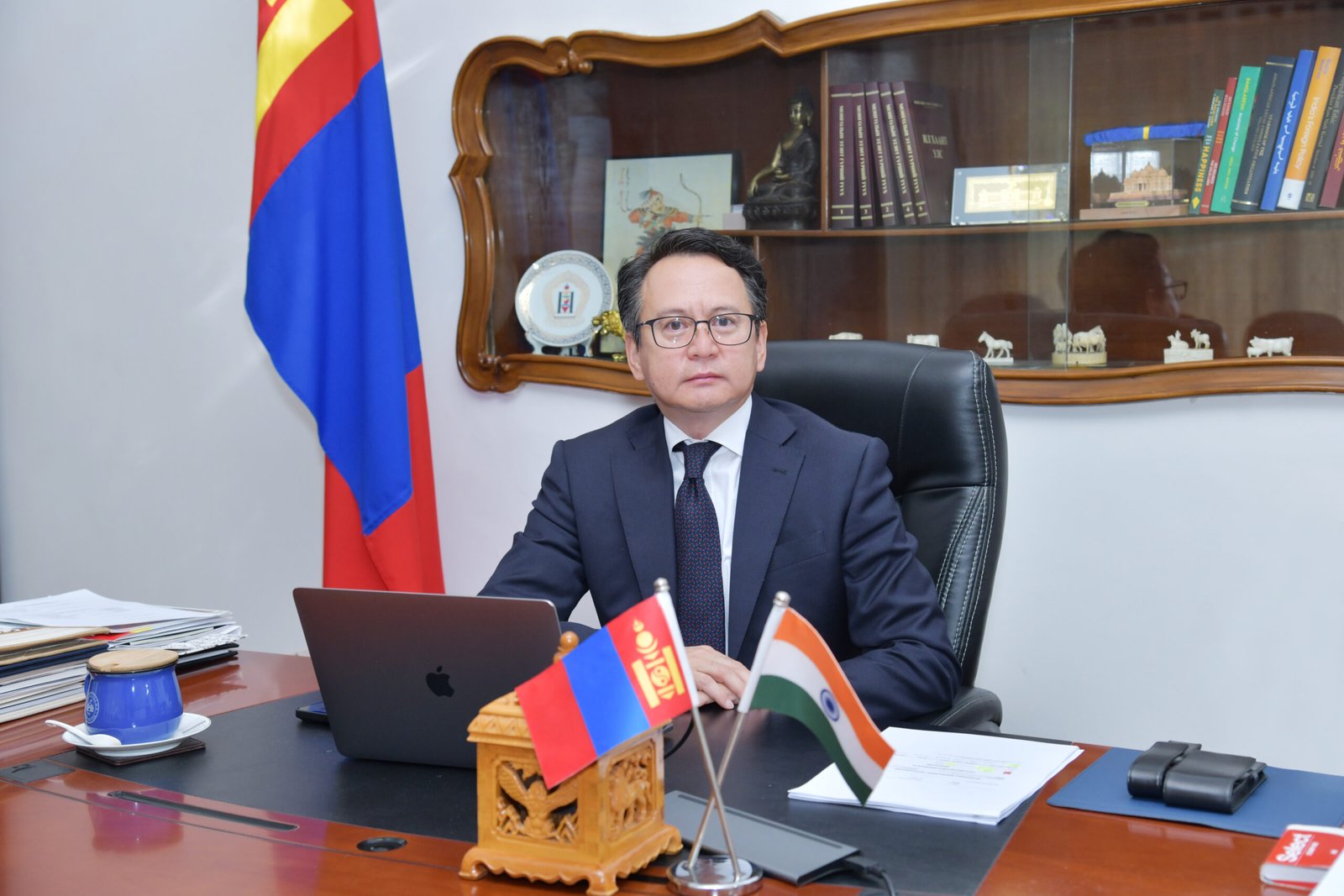
“We, the Mongolians, consider Indians as our Spiritual Neighbors”.
As Mongolia and India celebrate the 70th anniversary of diplomatic relations, how would you describe the evolution of bilateral ties between the two nations since 1955?What are the most significant milestones in this relationship?
The year 2025 marks a significant milestone in the history of Mongolia’s external relations, particularly with the Republic of India, as we commemorate the 70th anniversary of the establishment of diplomatic relations between our two countries. Diplomatic ties between Mongolia and India were formally established in December 1955, ushering in a new chapter in the long-standing, traditional friendship shared by our nations over many centuries.
Following the establishment of these relations, Mongolia opened its Embassy in New Delhi in 1956 – its first diplomatic mission outside the then-socialist bloc – underscoring the importance Mongolia attached to its relationship with India.
The ties between Mongolia and India are deeply rooted in history, with civilizational links dating back thousands of years. We remain profoundly grateful for India’s significant role in recognizing Mongolia’s independence and supporting our accession to the United Nations as a full-fledged member in 1961.
We take great pride in witnessing the steady evolution of our bilateral relationship. What began as a connection between Spiritual Neighbors has flourished into a robust Strategic Partnership in recent years, marked by growing cooperation across a wide range of sectors.
As we commemorate the 70th anniversary of our diplomatic relations in 2025, Mongolia looks forward to celebrating this historic occasion through high-level bilateral events that reflect the strength and depth of our enduring partnership.
What are the most significant outcomes of President Khurelsukh Ukhnaa’s October 2025 state visit to India — and how do they deepen the strategic partnership between Mongolia and India?
The State Visit of President Khurelsukh Ukhnaa has marked a new high in Mongolia–India ties, transforming friendship into a robust, multi-sectoral strategic partnership. First, the countries issued a comprehensive Joint Statement committing to deepen cooperation across economy, energy, minerals, agriculture, renewable energy, trade, education, culture and tourism, aligned with Mongolia’s “Vision 2050” and India’s development agenda.
A landmark achievement is the formal backing — via a US $1.7 billion line of credit — for Mongolia’s oil-refinery project, described by both sides as a “flagship symbol” of their cooperation and a major stride for Mongolia’s energy security and economic development.
On connectivity, both countries agreed to enhance transport and logistics links, including use of third-country ports and corridors, and charter flights between Mongolia (Ulaanbaatar) and Indian cities (Delhi and Amritsar), thereby boosting trade, tourism and people-to-people contacts.
Cultural and spiritual bonds — long central to Mongolia–India ties — were strengthened through renewed cooperation in Buddhist heritage, education and youth exchange. Agreements were signed for cultural exchange, heritage restoration, cooperative development, immigration/digital cooperation, and humanitarian assistance. India also offered new educational opportunities to Mongolian youth through scholarships and expanded exchange of expertise.
Finally, the visit underscored shared commitment to global and regional cooperation: both nations reaffirmed solidarity at multilateral forums, and pledged collaboration in energy transition (including Mongolia joining the International Solar Alliance), climate/environmental cooperation (through coordinated tree-planting campaigns), defence, and security cooperation — setting the stage for a stronger, future-oriented partnership.
In sum, the visit has converted diplomatic goodwill into concrete projects, policies and partnerships — spanning energy, infrastructure, connectivity, culture, education and defence — thus laying a durable foundation for a deeply integrated India-Mongolia strategic alliance rooted in shared values and forward-looking cooperation.
Mongolia and India share deep cultural and historical bonds, especially through Buddhism. How doyou see the role of cultural diplomacy in further strengthening ties between the two countries? Arethere any upcoming cultural exchanges or events planned?
India and Mongolia are two of Asia’s most ancient civilizations. Despite the considerable geographical distance between them, the civilizational ties that bind our nations span more than 2,700 years. These connections – rich, profound, and enduring – have transcended boundaries of language, literature, religion, medicine, folklore, culture, and tradition. The Mongolian “Kanjur” and “Tanjur” texts stand as enduring testaments to this deep-rooted and dynamic civilizational exchange. Given this profound historical legacy of interaction and assimilation, it is only natural that Mongolia and India have cultivated close and friendly relations in modern times.
In March 1947, shortly before India’s independence, a Mongolian delegation participated in the first Asian Relations Conference in New Delhi, convened under the leadership of Pandit Jawaharlal Nehru. This event marked the beginning of sustained contact between the two countries’ leadership, eventually culminating in the formal establishment of diplomatic relations on December 24, 1955. What began as a cultural and spiritual affinity – particularly through the shared heritage of Buddhism – has since evolved into robust political and diplomatic engagement.
The establishment of diplomatic relations was a pivotal moment in rekindling and strengthening the sacred bonds inherited from our forebears. For Mongolia, which sought international recognition of its sovereignty, and for India, newly independent from colonial rule, the initiation of formal diplomatic ties was of great international significance. Since then, bilateral relations have advanced steadily, marked by the regular exchange of high-level visits and dialogues. These interactions have consistently reaffirmed both nations’ commitment to the universally recognized principles of international relations: the promotion of world peace, mutual respect for sovereignty and independence, and non-interference in each other’s internal affairs.
The Government and people of Mongolia remain deeply grateful for India’s steadfast support in securing international recognition of Mongolia’s independence and sovereignty. Notably, in 1960, Prime Minister Nehru advocated for Mongolia’s admission to the United Nations during a session of the UN General Assembly. India’s decision to open its Embassy in Ulaanbaatar in 1970 further reflected the growing strength and maturity of the bilateral relationship, even during the complex geopolitical climate of the Cold War.
Since the early 1990s, as Mongolia embarked on a path of democratic and economic reforms, bilateral relations and cooperation with India have gained renewed momentum. In the past decade, high-level exchanges and state visits have contributed to the development of a comprehensive legal and institutional framework to guide future cooperation.
Mongolia regards India as a Spiritual Neighbor – a sentiment rooted in our shared Buddhist heritage and reverence for the sacred teachings of Lord Buddha, which originated on Indian soil. Historical records affirm that Mongolians studied at India’s renowned Nalanda University between the 5th and 8th centuries, while Indian scholars and aides served in the royal courts of Mongolian Khaans.
This enduring spiritual and cultural affinity was reaffirmed during the historic visit of Prime Minister Narendra Modi to Mongolia in May 2015 – the first-ever visit by an Indian Prime Minister. On that occasion, 13 bilateral agreements were signed, and, most significantly, the relationship between our two countries was elevated to the level of a Strategic Partnership.
Could you share your thoughts on how Mongolia-India relations in the fields of arts, cinema, and traditional music have evolved in recent years? What steps can both countries take to enhance cultural exchanges further?
One of the most vibrant and enduring areas of cooperation between Mongolia and India has been in the fields of culture and education. Generations of Mongolians, particularly among the elder and middle-aged population, continue to fondly recall the melodious charm of Indian music and cinema – especially the adventure and action films that captivated audiences for decades. During those formative years of cultural exchange, the regular flow of actors, artists, writers, and journalists between our two countries fostered deeper mutual understanding and brought our peoples closer together.
Following my appointment as Ambassador to India, I had the honor of witnessing a significant development in our bilateral ties with the visit of H.E. Mr. Gombojav Zandanshatar, Speaker of the State Great Hural (Parliament) of Mongolia, to India in late 2021. This high-level engagement provided fresh impetus to reinforcing our civilizational, historical, spiritual, and cultural bonds, and significantly advanced our diplomatic and inter-parliamentary cooperation.
It is with great pleasure that I share the appointment of the renowned Indian singer Mr. Mohit Chauhan as the Cultural Envoy of Mongolia. In this role, he has already collaborated with Mongolian artists and studios to produce two musical pieces. I am pleased to note that additional joint musical projects – three to four songs – are currently in development, further enriching our cultural exchange and artistic collaboration.
In another significant step forward, the Parliament of Mongolia has enacted the Law on Supporting the Film Industry. This legislation introduces an incentive program offering partial reimbursement of production costs to foreign legal entities that produce films for international distribution in collaboration with, or independently of, Mongolian entities. This initiative represents a major milestone for Mongolia’s art and cultural industries and opens promising opportunities for collaboration with India’s vibrant film sector.
Mongolia and India have a growing defense cooperation, with joint military exercises such as “Nomadic Elephant.” How do you envision the future of defense and security cooperation between the two nations? Are there any new areas of collaboration planned?
Since October 2003, Mongolia and India have witnessed notable progress in the field of defence cooperation. High-level exchanges, including regular visits by the Defence Ministers of both countries, have significantly contributed to strengthening bilateral ties in this important sector. In addition, regular consultative meetings are held between the Ministries of Defence of Mongolia and India. India has extended valuable support by offering training opportunities to Mongolian defence personnel, particularly in areas such as English language proficiency, peacekeeping operations, and military strategy. Current discussions are focused on increasing the number of Mongolian officers, sergeants, and cadets eligible to study in India, as well as enhancing the professional qualifications of military doctors and nurses. Collaborative efforts in the field of military medical care are also under active consideration. At present, annual training slots are consistently made available for Mongolian defence officers and personnel.
A landmark development in this cooperation was the initiation of the first-ever joint military exercise, Nomadic Elephant, held in Ulaanbaatar in October 2004. Since then, Nomadic Elephant has become a flagship bilateral training exercise, facilitating the exchange of operational experience and tactical expertise between the armed forces of our two countries. The exercise has earned international recognition for its scope and relevance in promoting regional stability and enhancing Mongolia’s defence capabilities. In a significant milestone, the Ambassador of Mongolia participated in the inauguration of the joint exercises for the first time in 2024. Looking ahead, we are committed to expanding the Nomadic Elephant exercises to incorporate additional themes such as medical services, disaster response, and humanitarian assistance. These enhancements will further enrich the exercise and deepen its practical benefits for both nations.
India also regularly participates in the internationally renowned Khaan Quest military field exercise, hosted by Mongolia. This continued engagement demonstrates the shared commitment of both countries to peacekeeping and multilateral military cooperation.
In recognition of the successful advancement of bilateral defence relations, a Defence Attaché was formally appointed to the Embassy of Mongolia in India in February 2024. This posting marks a new phase of closer military-to-military engagement and underscores the growing strategic dimension of the Mongolia-India partnership.
Medical cooperation between India and Mongolia has grown significantly in recent years. What morecan be done to enhance medical cooperation, including healthcare technology and patient carebetween the two countries?
It is noteworthy that the Ministry of Health of Mongolia and the Ministry of Health and Family Welfare of the Republic of India signed an Agreement on Cooperation in the Field of Health in 2009. Further strengthening this partnership, a Memorandum of Understanding was concluded in 2015 between the Ministry of Health of Mongolia and the Ministry of AYUSH of India to promote cooperation in the development of traditional medicine and homeopathy. More recently, in 2023, a cooperation agreement was also established with the World Laparoscopy Hospital, further expanding the scope of bilateral engagement in the medical sector.
Both countries are actively working to enhance cooperation in the health sector, with ongoing efforts to establish a joint working group focused on health assistance and the development of new healthcare services. In line with this initiative, the Ministry of Health and Family Welfare of India, in collaboration with the Chamber of Commerce and Industry of India, organized a Health Technology Expo in New Delhi in 2017. This event was attended by a high-level Mongolian delegation led by the Deputy Minister of Health. The expo featured participation from over 100 Indian health technology companies, showcasing advancements in medical equipment and healthcare solutions.
Within the current framework of cooperation, there is a growing need to intensify joint activities. These may include the participation of Mongolian doctors and specialists in international training programs and seminars related to medical care, diagnostics, and treatment; the exchange of experience between hospital management and clinical support teams; the provision of online consultations and information-sharing on diagnostic techniques and treatment protocols; and collaboration in medical science, research, and innovation. Additionally, arrangements for referring Mongolian patients for diagnosis and treatment in Indian healthcare institutions are being actively explored.Delegations of Indian medical professionals continue to visit Mongolia regularly, engaging in consultations and discussions with both public and private hospitals. These interactions play a vital role in strengthening institutional linkages and enhancing the overall quality of healthcare delivery in both countries.
Education is another key area where India has contributed, including through scholarships forMongolian students. How successful has the educational exchange program been, and how can weexpand it in the future to support more students from Mongolia?
The education sector plays a vital role in fostering and deepening the bilateral relationship between Mongolia and India. The Government of India provides annual ICCR scholarships to Mongolian students for higher education in India, particularly in fields such as Information Technology and Engineering. These students, upon completion of their studies, are expected to contribute significantly to Mongolia’s socio-economic development and will benefit from enhanced career opportunities in the future.
In addition to the scholarship programme, India extends training opportunities to Mongolian nationals under the Indian Technical and Economic Cooperation (ITEC) Programme. Each year, numerous training slots are allocated for courses across a wide range of disciplines including agriculture, small and medium-scale industries, information technology, banking, management, and rural development. These capacity-building programmes have made a considerable contribution to the development of Mongolia’s human resources and institutional capacities.
Pursuant to a bilateral agreement, India established the Indo-Mongolia Joint Higher Secondary School in Ulaanbaatar in September 2003. Currently, five Indian teachers are stationed at the school, where they teach English, Information Technology, and Mathematics.
In the field of Information Technology, the Government of India, through a grant, establishing the Atal Bihari Vajpayee Centre for Excellence in Information and Communication Technology in Ulaanbaatar. The Centre shall be equipped with state-of-the-art computer laboratories and a video conferencing facility – the only one of its kind in Mongolia – making it a cornerstone of bilateral cooperation in digital education and training.
Mongolia is home to numerous invaluable manuscripts that form a critical part of the world’s cultural and literary heritage. The Governments of India and Mongolia have agreed to jointly digitize these rare and ancient manuscripts to ensure their preservation for future generations and to make them accessible to scholars and researchers globally.
Looking ahead, a major educational initiative is being planned to bring approximately 1,000 Indian English language teachers to Mongolia, with a particular focus on deploying them in rural areas. This project is expected to serve multiple objectives: it will provide Mongolian students – especially in remote regions – with direct exposure to native-level English instruction, thus enhancing language proficiency across the country. Additionally, the presence of Indian educators will foster greater cultural exchange by introducing Mongolian communities to India’s rich heritage, including its history, festivals such as Holi and Diwali, and traditional customs. In return, Indian teachers will gain valuable insights into Mongolian society, culture, and way of life, further strengthening people-to-people ties between our two nations.
Buddhism is a spiritual bridge between Mongolia and India, with shared heritage sites and religious practices. How do you plan to utilize this spiritual connection to further deepen people to people tie and promote religious tourism between the two nations?
With regard to religious tourism, it is noteworthy that the Government of Mongolia has declared the period from 2023 to 2025 as Visit Mongolia Years in an effort to promote tourism as a key pillar of economic diversification. Experts and researchers widely recognize tourism as one of the most vital sectors for Mongolia’s long-term economic development. For the people of Mongolia, India holds deep spiritual significance as the Land of Lord Buddha, while Mongolia, in turn, is regarded as one of the “Three Dharma Nations.” In this context, there is significant potential for the development of Buddhist pilgrimage tourism, which would not only contribute to economic growth but also further enrich the centuries-old spiritual and historical connections between our two countries.
In recognition of our shared religious heritage, the Government of India generously allocated a plot of land in Bodh Gaya for the construction of a Mongolian Monastery. Since becoming operational in 2008, the Monastery has served as a symbol of our spiritual bonds and a place of reverence for Mongolian pilgrims and monks. In return, the Petub Monastery – founded by the late Ambassador Kushok Bakula Rinpoche, who served as the Ambassador of India to Mongolia for over a decade – has, since its establishment in Ulaanbaatar, played a significant role in fulfilling the spiritual needs of the faithful. In addition to its religious function, the monastery has been actively involved in cultural and humanitarian activities, thereby serving as a bridge of spiritual and cultural exchange between the two countries.
The second visit of the Sacred Relics of Lord Buddha to Mongolia in June 2023 served as a significant milestone in further strengthening the spiritual and cultural bonds between our two nations. Building on this momentum, plans are currently underway to bring the relics of two of Lord Buddha’s principal disciples to Mongolia during the summer of this year. This initiative is expected to further deepen the shared spiritual heritage and foster closer ties between the peoples of Mongolia and India.
Furthermore, to foster deeper academic and cultural engagement, the Government of India has established a Chair for Mongolian Studies at Jawaharlal Nehru University in New Delhi. In a reciprocal initiative, a Chair in Sanskrit and Buddhist Studies has also been instituted at the National University of Mongolia. These academic exchanges serve to promote mutual understanding and preserve the rich literary and spiritual traditions shared by our nations.
The profound spiritual connection between India and Mongolia continues to be a cornerstone of our bilateral relationship. Strengthening this dimension will not only enhance people-to-people ties but also open new avenues for the promotion of religious and cultural tourism between our two countries.
There have been several high-level visits between India and Mongolia in recent years. How havethese visits contributed to strengthening the strategic partnership, and can you share any insights on contributed to strengthening the strategic partnership, and can you share any insights on upcoming bilateral engagements?
Regular high-level bilateral visits have played a pivotal role in promoting and strengthening the modern relationship between Mongolia and India. We are pleased to note that our bilateral cooperation has significantly expanded across multiple sectors and is now advancing in alignment with the principles of a Strategic Partnership. It is a matter of great satisfaction to emphasize that this Strategic Partnership will continue to deepen in scope and substance. We remain fully committed to working collaboratively in key areas such as economic development, defence cooperation, education, tourism, and people-to-people exchanges – guided by Mongolia’s “Third Neighbour” and India’s “Act East” policies.
In the context of broadening bilateral cooperation, particular emphasis is being placed on enhancing collaboration in sectors such as the economy, mining, information technology, culture, education, and humanitarian affairs. Of special significance is the Oil Refinery Project, which stands as a landmark symbol of our Strategic Partnership. We are diligently working to ensure its successful implementation. In parallel, other joint initiatives and programs are also being actively developed to further strengthen our bilateral engagement.
As part of the solemn commemoration of the 70th anniversary of the establishment of diplomatic relations between Mongolia and India in 2025, we are implementing a series of high-level mutual visits and joint activities. In celebration of this milestone, a series of international conferences have been organized, focusing on our historical bonds, the achievements of the past 70 years, and a shared vision for the decades to come. The official launch of the 70th anniversary celebrations was marked by a reception hosted by the Ambassador of Mongolia to India on March 19, 2025, where Hon’ble External Affairs Minister Dr. S. Jaishankar and State Secretary H.E. Mr. L. Munkhtushig delivered significant remarks on the enduring strength of our bilateral relations. To mark the occasion, commemorative joint postal stamps were simultaneously released in Ulaanbaatar and New Delhi. Additionally, a series of publications highlighting the historic and spiritual ties between our nations are currently being prepared for release.
In light of these developments, it is evident that Mongolia and India have sustained close and mutually beneficial relations over the past seven decades. I am confident that our deep-rooted historical ties will gain renewed momentum in the coming years, further drawing our two ancient civilizations closer together and ushering in a new era of partnership and shared progress.
Would you like to give any message to our Envoy Excellency readers?
Mongolia accords great importance to India as one of its most significant “Third Neighbours” in the region. The deep-rooted bonds between the peoples of Mongolia and India are steeped in centuries-old traditions and mutual respect. Our two nations regard each other as Spiritual Neighbors, a relationship built upon a shared religious and cultural heritage. Numerous historical and cultural documents testify to this profound connection, including the sacred texts of the Kanjur and Tanjur, which are carefully preserved in Mongolia.
We follow with great admiration the remarkable progress India has achieved in recent years. India’s rapid development and global leadership provide a strong foundation for expanding and deepening our bilateral cooperation, particularly in the fields of information technology, education, and culture. We cherish the vision of advancing hand in hand, united in our pursuit of progress and mutual prosperity.
Moreover, both sides are committed to contributing to global economic growth by diversifying economic cooperation into emerging sectors. Mongolia and India have actively collaborated to promote strategic consumption, enhance regional security, strengthen bilateral trade, and ensure the steady supply of essential commodities, including food and pharmaceutical products, to the Mongolian market.
What inspires me personally—and compels me to strive for new avenues of cooperation—is the historical legacy of our ancestors, who crossed the Himalayan mountains barefoot and without the means of modern transportation, driven solely by their conviction to nurture and expand the ties between our peoples. Today, with every means of communication and technology at our disposal, we are well-positioned to achieve far greater accomplishments in our bilateral partnership.
As we commemorate the 70th anniversary of the establishment of diplomatic relations between Mongolia and India in 2025, I would like to reiterate that India was the first non-socialist country to recognize Mongolia’s independence. Furthermore, India was the first nation to formally advocate for Mongolia’s membership in the United Nations. The people of Mongolia remain deeply grateful for this enduring support.
On this auspicious occasion, I extend my heartfelt congratulations to the people of India. I am confident that the multifaceted relationship between our two nations will continue to flourish in the years ahead. As Strategic Partners and Spiritual Neighbors, Mongolia and India will continue to strengthen their partnership, guided by shared values, historical affinity, and mutual aspirations for peace, development, and prosperity.
Thank you.