

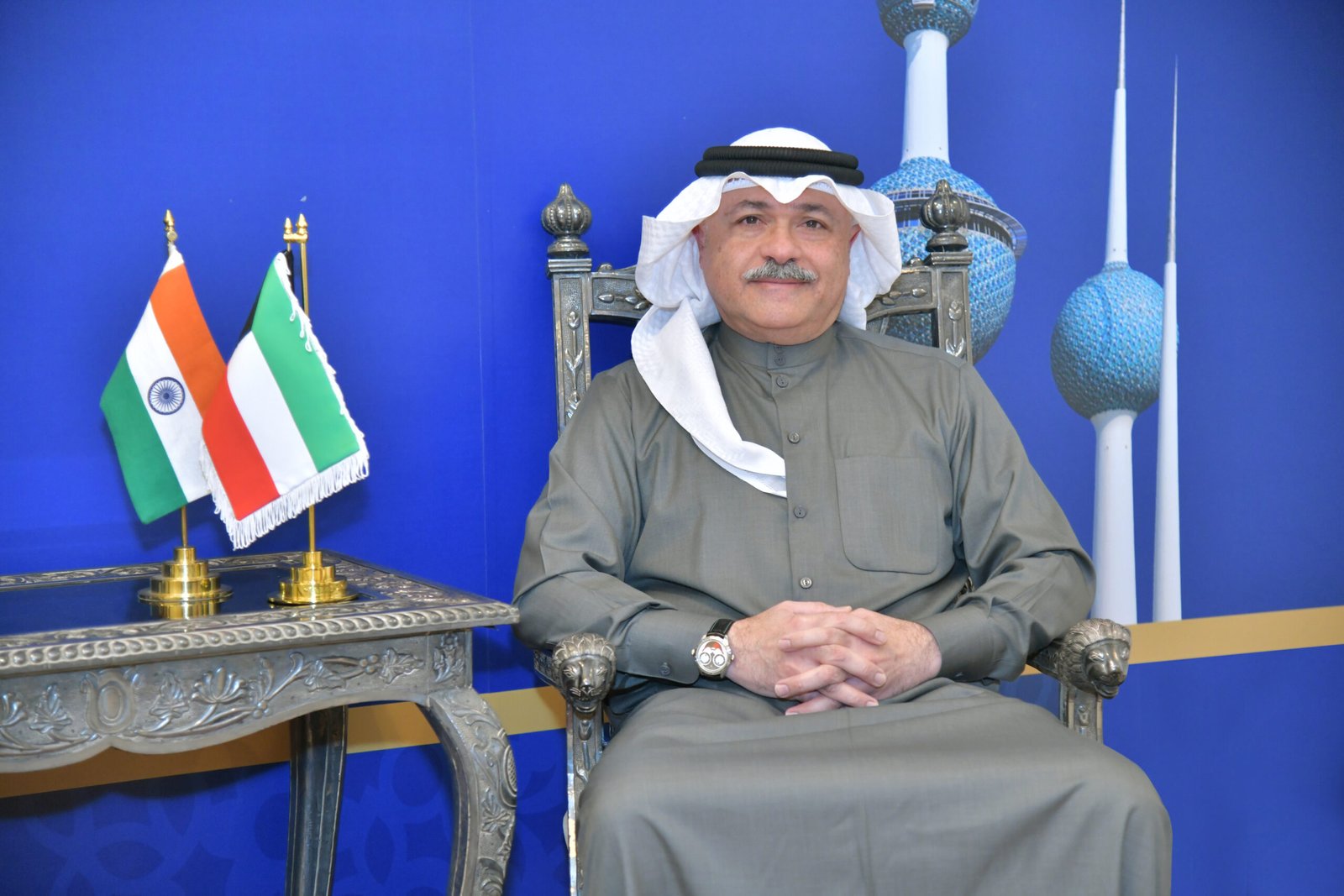
“The future of Kuwait-India relations looks promising for multifaceted partnership.”
As Kuwait and India celebrate the 65th anniversary of their bilateral relations, how would you describe the evolution of this partnership, and what new dimensions do you foresee for the years ahead?
Kuwait and India have always had close ties and the historical relations between both the countries have significantly deepened in recent years with bilateral agreements, trade boost and increased investments, shaping a new era of collaboration.
India-Kuwait relations have evolved from traditional friendship to a Strategic Partnership, deepening across defense, energy, technology, healthcare, food security, and cultural ties, marked by a large Indian diaspora and recent high-level agreements, with future dimensions focusing on shared tech goals, increased connectivity, and joint economic ventures.
In this context, the future of Kuwait-India relations looks promising for multifaceted partnership. Both nations are keen to explore new avenues of cooperation, including renewable energy, healthcare, technology, education, food security and cyber security. The focus is on sustainable development and leveraging each other’s strengths to achieve common goals.
The 7th India-Kuwait Foreign Office Consultations were recently concluded. What were the key outcomes, and how do they strengthen cooperation across sectors such as energy, trade, security and people-to-people ties?
The 7thround of Foreign Office Consultations between the State of Kuwait and the Government of India were held on 26 August 2025 in New Delhi, co-chaired by H.E. Ambassador Sameeh Essa Johar Hayat, Assistant Foreign Minister for Asia Affairs (AFM), Ministry of Foreign Affairs of Kuwait and Shri Aseem R. Mahajan, Additional Secretary (Gulf), Ministry of External Affairs of India, where both sides undertook a comprehensive review of the bilateral relations and exchanged views on regional and international issues of mutual interest.
They agreed to accelerate the implementation of the existing “Strategic Partnership” roadmap across various sectors, including political, trade, investment, defence, energy, and culture and people-to-people ties.
The primary outcome was the commitment to fast-track the roadmap drawn out under the guidance of the leadership of both the countries during the visit of Hon’ble Prime Minister Shri NarendraModi to the State of Kuwait Kuwaiton December 21-22, 2024, which elevated the bilateral relationship to a Strategic Partnership. This commitment ensures high-level political guidance continues to drive cooperation between both the countries.
Kuwait is emerging as a promising destination for global investors. Which sectors currently offer the most attractive opportunities for Indian businesses, and how is your government facilitating foreign investment?
Kuwait is actively positioning itself as an attractive investment hub by diversifying beyond oil into tech, infrastructure, healthcare, and tourism, offering attractive incentives like long-term residency (up to 15 years) to eligible global investors, providing stability and encouraging commitment.
Kuwait and India have a strong economic relationship, with India being a top trading partner of Kuwait. The State of Kuwait is committed to attract foreign investment, particularly from India, and for this, it recently launched a new investment promotion strategy that is specifically targeting Indian investment in a variety of promising sectors, including infrastructure, manufacturing, tourism, health and energy.
The State of Kuwait facilitates foreign investment through new laws and a dedicated authority, offering incentives like 100% foreign ownership, tax and customs exemptions, and streamlined procedures via the Kuwait Direct Investment Promotion Authority (KDIPA). The country also allows foreign companies to open branches without a local agent and is promoting public-private partnerships in various sectors to attract capital and expertise.
Tourism is expanding worldwide as a major economic sector. How is Kuwait developing its tourism infrastructure, and what new experiences is the country creating to welcome international visitors, including those from India?
The government of the State of Kuwait is rapidly developing tourism sector through its Vision 2035 by launching the unified “Visit Kuwait” digital platform, major infrastructure like “Winter Wonderland”, cultural hubs (Sheikh Jaber Cultural Centre), and big projects (Silk City) to attract global visitors, including Indians, by simplifying entry, promoting sports/culture, and enhancing experiences with faster visas and diverse attractions, as seen in recent 2025 initiatives taken by the government to promote tourism in the country and to highlight its cultural heritage and hospitality, inviting people of different cultures to learn about Kuwait’s history and traditions.
The improvement of tourism services, with a focus on quality and customer satisfaction, has contributed to this growth, leading to higher satisfaction levels among visitors. For a society like Kuwait, with which India shares a rich historical connection, Kuwait’s tourism opportunities are an invitation to explore and deepen the shared cultural ties between both the countries.
Climate change is a global priority. How is Kuwait addressing climate challenges, and what role does the country aim to play in advancing sustainable development and environmental protection in the region?
Kuwait is tackling climate change through a national vision “New Kuwait 2035” focusing on economic diversification andsustainability, aiming for achieving net zero greenhouse gas emissions by 2050, boosting renewables (15% by 2030 target), improving energy efficiency, reducing subsidies, raising awareness and exploring blue hydrogen, all while developing adaptation plans, positioning itself to lead regional green transition via technology and finance.
The State of Kuwait plays an important role in advancing sustainable development and environmental protection in the region by engaging in strategic partnerships with international bodies like the UN Environment Programme (UNEP) to develop regional strategies, and by upholding regional and international environmental resolutions, acting as a model for sustainable transitions in the Gulf, all while aligning with global SDGs and regional environmental initiatives.
With Kuwait joining the International Solar Alliance (ISA), how do you envision deeper energy and climate cooperation with India, particularly in the fields of renewable power and clean-energy technologies?
Kuwait’s membership in the International Solar Alliance (ISA) marks a pivotal moment, elevating the existing relationship with India from a traditional hydrocarbon trade dynamic to a strategic partnership in the clean energy transition. This collaboration is envisioned to deepen through technology transfer, joint ventures, and shared policy frameworks, supporting both nations’ sustainability goals.
Deeper energy and climate cooperation with India will focus on several key areas, such as Scaling Solar Power Infrastructure, Developing Clean-Energy Technologies, Investment and Financial Mobilization, and Policy Dialogue and Knowledge Sharing. Furthermore, Cooperation via the International Solar Alliance (ISA) framework could facilitateJoint Solar Park Development, Rooftop Solar Implementation, Innovation and Research, while fostering new employment opportunities in both countries.
Digital transformation is shaping every aspect of modern governance. What is Kuwait’s long-term vision for digitalization, and are there any ongoing or planned collaborations with India in areas such as ICT, fintech or e-governance?
Kuwait’s long-term vision for digitalization is a core component of its “New Kuwait 2035” national development plan, aiming to transform the country into a regional financial and commercial hub by diversifying its economy away from oil. Kuwait’s digitalization strategy is driven by the Central Agency for Information Technology (CAIT) and the Communications and Information Technology Regulatory Authority (CITRA), focusing on several key pillars, such as E-Governance, Smart Cities, Digital Economy and Fintech, Infrastructure & Cybersecurity, and Human Capital Development.
During the visit of Hon’ble Prime Minister of IndiaShri NarendraModi, to the State of Kuwait in December 2024,both nations identified “digital transformation and technological synergies” as potential areas for collaboration. The joint statement explicitly mentioned exploring Business-to-Business (B2B) cooperation, furthering e-governance, and sharing best practices in the electronics and IT sectors.
A specific Memorandum of Understanding (MoU) was signed between the Financial Intelligence Units (FIUs) of India and Kuwait in July 2025 to enhance cooperation in combating money laundering and terrorist financing.
Kuwait is actively pursuing smart city projects and enhancing its ICT infrastructure as part of its economic diversification strategy. India’s experience in large-scale digital transformation, fintech innovation, and e-governance creates a natural alignment for bilateral collaboration. Indian tech companies can play a crucial role in helping Kuwait build digital highways, e-services, and smart governance platforms.
The concept of a Kuwait “Golden Visa” has attracted global attention. Could you elaborate on its features, objectives and how it is designed to support skilled professionals, investors and entrepreneurs?
The State of Kuwait has introduced a new “Golden Visa” system offering long-term residency (10-15 years) for investors, property owners, and children of Kuwaiti mothers, to attract capital and talent, with 15 years for major investors and 10 years for property owners/family, requiring health insurance and case-by-case review for investment.
The concept of Kuwait “Golden Visa” is meant to give more stability to foreigners who invest, own property or have family ties in Kuwait, and to make the country more attractive to business and skilled talent, apart from boosting the national economy and ensuring long-term stability for expatriates who contribute significantly to the country.
With Kuwait being home to a large and valued Indian diaspora and workforce links between the two countries long established, how is the Embassy working to enhance mobility, labour cooperation and mutual opportunities?
A large and well-established Indian community of over one million people provides strong social and cultural networks for new and existing workers.Indian workforce constitutes 21% of the total population of Kuwait and 30% of its work-force. They are working in Private Sector as well as Domestic Sector and thus contributing to the socio-economic development of the State of Kuwait.
The Embassy of the State of Kuwait in New Delhi, alongside Indian authorities, enhances labour mobility and cooperation through regular Joint Working Group (JWG) meetings, signing MoUs (like for domestic workers in June 2021), facilitating legal recruitment, protecting worker rights via contracts and support, promoting skill recognition, and strengthening broader economic ties in defence, energy, and tech, all while managing the massive Indian diaspora in Kuwait for mutual benefits.
Would you like to give any message to our Envoy Excellency readers?
I would like to thank the readers of ‘Envoy Excellency’ for their keen interest in international affairs and exploring Kuwait-India relations, encouraging them to explore rich heritage, investment opportunities, and cultural vibrancy of the State of Kuwait, as we embark on a future of mutual growth and prosperity. I convey them that the future of bilateral relations between both the countries looks promising for multifaceted partnership. Both nations are keen to explore new avenues of cooperation, including renewable energy, healthcare, technology, education, food security and cyber security. Both nations are working on sustainable development and leveraging each other’s strengths to achieve common goals. I would like also to thank the Indian community in Kuwait for their dedication to work and giving a beautiful image of Kuwait-India relations.