

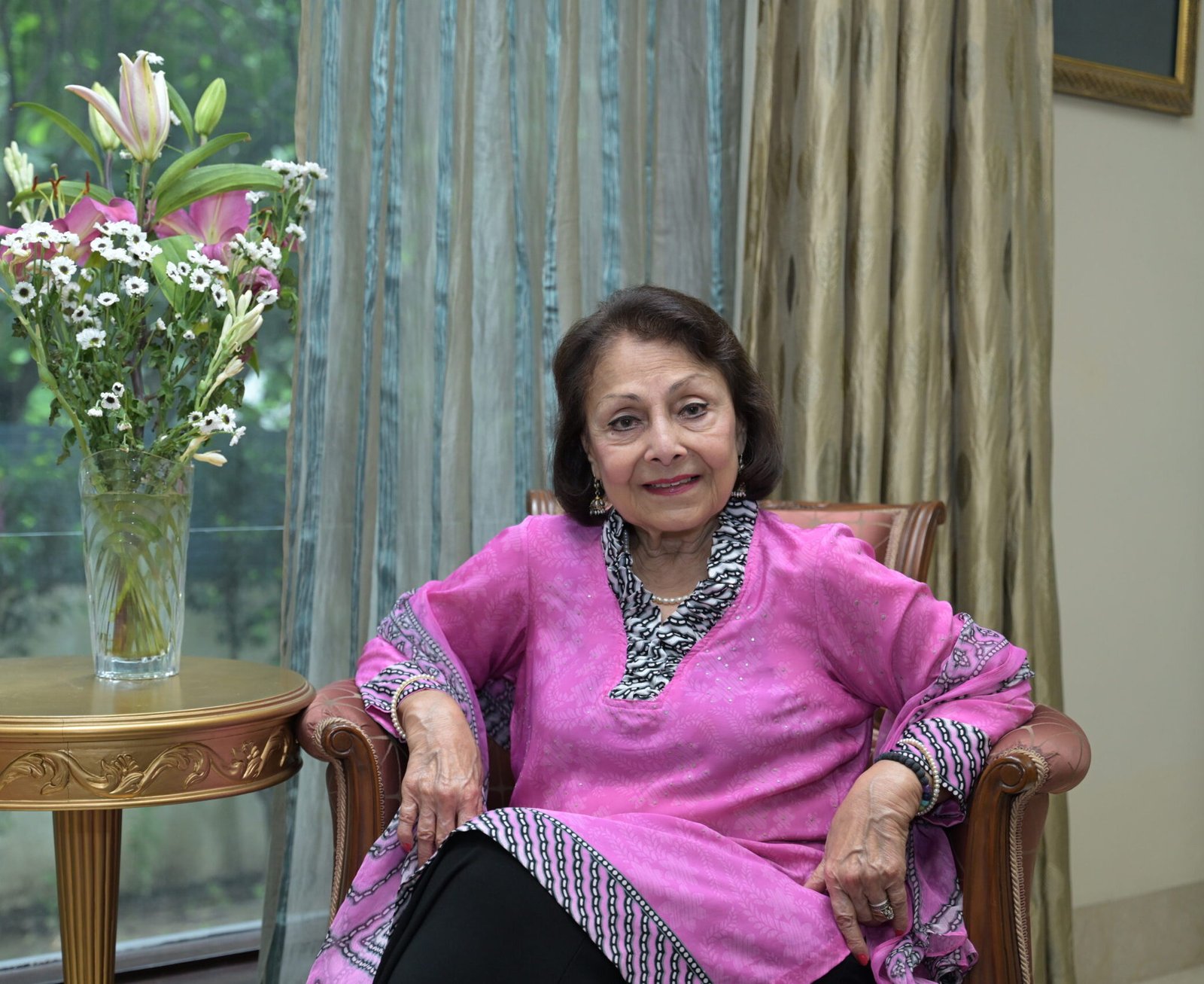
Art, music, and culture serve as the most spontaneous bridges between nations.
Your formal artistic training spanned watercolor painting in Canada and bronze sculpture in India. How have these distinct traditions and techniques shaped the artistic style and themes of your visual art?
I view these techniques simply as wonderful tools to translate mental concepts into tangible art—whether through paint on paper, or clay cast into bronze, or fiberglass. The real trigger was my life’s journey: my family had frequent transfers, as my father was in the Army Medical Corps of India. We were posted in many parts of India, and he also had a long posting an avid interest in understanding what made human beings so similar, yet uniquely different.
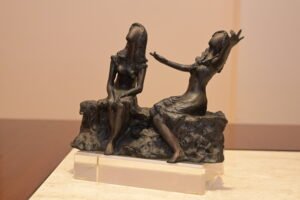
Then when Trinidad and Tobago became my home by marriage, I was fascinated by this most multi-ethnic country, composed of people from almost every continent and above all, the extraordinary preservation of Indian culture and traditions there! Indians were first taken to Trinidad during British colonial rule in 1845 under a 5-year contracted programme of Indentureship that ended in 1914. Today they comprise 43% of the population and as a TV writer/director I captured this remarkable preservation in 3 major television productions: ‘Mehefil’ and ‘Humsafar’ showcasing their brilliant talent in Indian music, song and
dance and the documentary series, ‘Yatra – The Journey of the Indian Presence in Trinidad and Tobago’ capturing the history, sociology, cultural practices and traditions, festivals, cuisine, dress and more. The mediums of Fine Art, be it film, watercolour, clay or bronze sculpture became tools to tell a story, or capture a moment, a mood, a memory.
As someone who has promoted both India and Trinidad and Tobago relations during diplomatic assignments worldwide, what role do you believe visual arts play in fostering international dialogue and cross-cultural understanding?
Cross-cultural undestood without leaving the viewer wondering what it means. Art, music, and culture serve as the most spontaneous bridges between nations. While reading news informs us about world politics, interacting with live performances or visual art creates a lingering memory and genuine knowledge of another nation and its culture. During my husband’s several diplomatic assignments abroad, I felt it was important to showcase Trinidad and Tobago’s multi ethnicity and festivals through art, so I created several thematic sculptures and paintings telling the story. I also scripted and produced a major stage cum video productions titled ‘The Rainbow that is Trinidad and Tobago’ that was performed in 4 cities of India during our former Prime Minister, Basdeo Panday’s official State visit. Another stage/ video show was ‘Traditions in Music’. We held a festival titled, ‘Real Colours – A Trinidad and Tobago Extravaganza’ for 3 consecutive years in Miami, USA when my husband was Consul General. Our effort was always to create a deeper and better understanding of our twin island country through the arts to the wider, mainstream community.
Could you please share the story behind one of your paintings?
One of my paintings captures the Tassa drum of Trinidad (pronounced Tasha in India) brought by early indentured workers and traditionally played during Muharram processions. The early immigrants carried whatever they could in their jhanji bundles—seeds, memories, the Ramayana, Bhojpuri songs, the Sarangi and their drums. Over time, there were many creative adaptations based on what was available, especially in cuisine and the making of instruments. In my painting, I captured the complete live ensemble: the lead drum holding the main rhythmic beat, the Fulé drum accompanying it, the bass drum giving depth, and the Jhange, or cymbals, adding a metallic resonance. Adapted in Trinidad, the drum painting, I captured the complete live ensemble: the lead drum holding the main rhythmic beat, the Fulé drum accompanying it, the bass drum giving depth, and the Jhange, or cymbals, adding a metallic resonance. Adapted in Trinidad, the drum became deeper and heavier as it was made of clay and amazingly today, captures rich bass sounds that are part of the Caribbean. Other than the traditional Chawbola and Muharam beats from India, a Tassa side also plays the indigenous Calypso and especially in cuisine and the making of instruments.
Dingolay rhythms. Today, it is heard accompanying not only Muharram processions with exquisitely crafted Tajiyas, but also at Indo-Trinidadian weddings (during the Milni and to herald the arrival of the groom). Interestingly, in recent years it is also heard at Carnival and at national celebrations. Chutney singing is another innovation of T&T where remembered Bhojpuri songs from the mother land were given a Chatak (hot and spicy) beat on the Dholak drum and with the addition of a few English words, accompanied by a vibrant contemporary music band, they took on a new form… this was the birth of Chutney music!
Having exhibited in prominent international showcases such as the Triennale of Modern Art in New Delhi and the Joint Latin American and Caribbean Exhibition in Miami, how does a diverse global audience connect with your depiction of Caribbean and Indian culture?
Exhibition audiences are naturally curious. Because I prefer realism over abstract art, I chose to share the artist’s point of view in my title. Exhibitions are a learning experience for the viewer. Art tells a story poetically by capturing a special moment, and titles help guide that understanding. I found tremendous curiosity because very little was known globally about the Indian diaspora in Trinidad and Tobago, Guyana, Suriname, Fiji, and Mauritius. I felt obliged to capture it through art—such as The Girl Grinding Masala, showing a woman using a traditional Sil and Lordha (2 grinding stones), and the Jhata, depicting a traditional stone mill (Chakki) sculpted in white clay with two women singing while they turn the stone. My other works capture Trinidad’s Carnival, it’s Flora and Fauna and other festivals.
Beyond painting and sculpture, your background encompasses classical Odissi dance, stage production, and thematic design. How do the movement, rhythm, and storytelling of the performing arts influence your approach to visual art?
Visual art has permanence. Something captured in a tangible form—be it canvas, paper, clay, bronze, fiberglass— the medium preserves a story, forever. My training in classical Odissi heavily influences me. Odissi is a sacred, narrative dance originally performed as devotion (seva) to Lord Jagannath in Puri, Odisha. Dance is defined by movement and expressions that tell the story. The way fabric catches the cadence of dance, is poetic. I am always delighted to freeze that dynamic motion of dance into a permanent art form.
Could you elaborate on your sculptures and the stories they tell?
I was driven to create works capturing the art forms of Trinidad and Tobago because during my husband’s diplomatic postings, it was necessary to showcase the country’s vibrant, multi-ethnic, creative culture. We did the same with the culinary arts, presenting multi-ethnic Trinidadian cuisine at Food Festivals. Carnival is an extraordinary festival that began with freed men and women expressing their freedom through street dancing, costumes, and music. It’s interesting to note that for Carnival, new songs by celebrated Soca and Calypso singers drive the annual Panorama competition each year. ‘Panorama’ is the name of the Steel pan Orchestra competition. Small, medium and large Steel Orchestras compete to win the coveted prizes.
My multi-ethnic sculptures celebrate:
- Traditional ‘Ole Time’ Masquerade: A fibre glass sculpture that captures traditional masquerade (Traditional Mas) characters, such as the Indian Warrior with his plumes and shak-shak (maracas), the Midnight Robber with his oversized hat and boisterous speech, the Pierrot Grenade holding the “Book of Life,” the Horroppo, much like the Kachi Ghori of India, and the winged Bats that dance, dip and weave through the thousands that come to observe Trinidad and Tobago’s extraordinary Carnival.
I Feel the Music: Sweet Pan: A bronze sculpture celebrating Trinidad’s unique Steelpan instrument. The player’s head and hands are raised heavenward in pure musical ecstasy.
Girl, Dance the Bele! Captures a female dancer performing the French-influenced Bel-Air (Bélé) folk dance and freezes her motion and the momentum of her large, billowing skirt as she spins and twirls.