

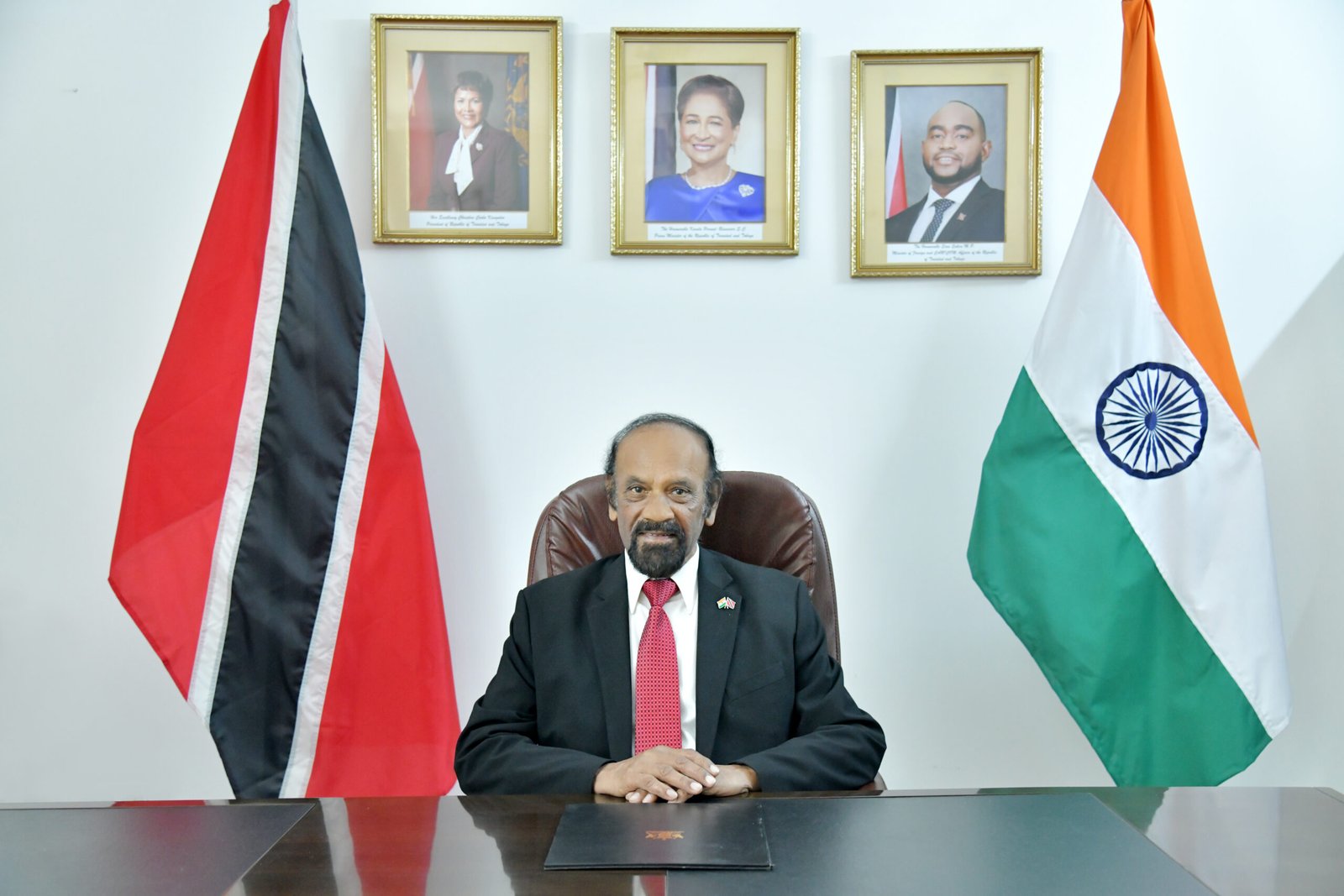
“Trinidad and Tobago and India enjoy excellent relations, both
historically and in terms of a growing trade and investment partnership.”
Trinidad & Tobago – India relations have deep historical and people-to-people foundations. How do you assess the current state of bilateral relations, and what areas hold the greatest promise for future cooperation?
Bilaterally, Trinidad and Tobago and India enjoy excellent relations, both historically and in terms of a growing trade and investment partnership. As far as I am concerned, the greatest promise with this partnership has to do with people to people contact and the development of new and creative industries for future cooperation. The areas that hold the greatest promise for future cooperation between our two countries have to do with the unprecedented attention Prime Minister Modi’s Government is paying to Caribbean Governments and in particular the Indian Diaspora communities throughout the region. India is a true champion of South South Cooperation and is prepared to assist developing countries in those areas in which India is the leader among nations including AI.
Indian Prime Minister Narendra Modi’s official visit to Trinidad & Tobago in July 2025 has been described as historic. In your view, what were the most important outcomes and takeaways from this visit?
The most important outcomes from Prime Minister Modi’s recent visit to Trinidad and Tobago, were reinforcing our historical ties and also charting a new course for economic cooperation, including technical assistance from India. Stronger collaboration at the international level with particular reference to South South Cooperation is another major outcome. The Prime Minister’s visit, though personalised to Trinidad and Tobago, should also be seen as a benefit for the entire CARICOM Region of which Trinidad and Tobago is a strong member. Of course, one of the outcomes of the visit has to be the tremendous publicity it received in India and the benefits of this in enhancing our relations.
Trinidad & Tobago is often viewed as a gateway to the Caribbean region. What investment opportunities would you highlight for Indian companies, especially in sectors such as energy, ICT, pharmaceuticals, infrastructure, tourism and innovation?
The Trinidad and Tobago’s economy is heavily based on energy industries which provide ample opportunities for Indian companies to get involved in various sectors. As far as ICT is concerned, we are very keen to quickly develop this sector and we could find no better partner to help with this than India. Our ICT doors are open to Indian investors. Pharmaceuticals is a heavily targeted area for Indian investors in Trinidad and Tobago. We are traditionally a major importer of Indian pharmaceutical products but we would like to invite Indian companies to establish production facilities in our country to satisfy our domestic market and also capitalise on our excellent location to penetrate the wider market in the Caribbean, the Americas, (North, South and Central) as well as the E.U. My Government recently unveiled the blueprint for revitalising the economy, which provides vast opportunities for the Indian construction sector to get involved. Tourism is of course one of our major industries. We are now determined to attract more Indian visitors who must come and enjoy our enchanting beauty, unique and fascinating culture and of course cricket.
The recent change of government in Trinidad & Tobago naturally brings renewed priorities. What foreign policy directions or strategic shifts do you foresee under the new administration, especially regarding India?
The foreign policy of Trinidad and Tobago has already started to shift strategically. Our recent election, by a unanimous majority vote, as a Non-Permanent Member of the UN Security Council is an indication of that shift. Our Prime Minister, during her previous term as Prime Minister, established a strong presence internationally as an aggressive and committed leader in International Affairs. You can expect Trinidad and Tobago to continue on these strong Foreign Policy initiatives including closer collaboration with India in areas of mutual interests.
What specific measures is the Government of Trinidad & Tobago taking to make the country an attractive destination for Indian investors and businesses?
The launch of the Trinidad and Tobago Revitalisation Blueprint of the Economy has opened up unprecedented opportunities for foreign investment. This comes with a package of incentives and measures, making it easy to do business in the country. Other measures to protect and encourage investment have also been instituted. As far as Indian investors are concerned, please bear in mind that 43% of the population in Trinidad and Tobago is of Indian origin, presenting a ‘little India’ to them when they arrive in my country. Apart from this, Trinidad and Tobago has a huge workforce of highly skilled workers in offshore, deep water exploration for oil and gas.
Do you expect Trinidad & Tobago – India engagement to become more strategic in emerging areas such as digital transformation, fintech, healthcare partnerships and Global South Cooperation?
Trinidad and Tobago’s relations have entered the phase of strategic planning and enhanced engagement especially after the recent visit by Prime Minister Modiji followed by the visit of External Affairs Minister Jaishankar. The launch of the Trinidad and Tobago Revitalisation Blueprint of the Economy which Trinidad and Tobago recently announced, has created scope for collaboration in strategic areas like digital transformation, fintech, healthcare partnership and South South Cooperation. India is in fact leading the way in South South Cooperation by reaching out to Small Island Developing States and providing technical assistance in several critical areas while at the same time opening up the Indian economy making it easier for us to do business with India and narrow the trade gap between our two countries.
High-level exchanges often shape diplomatic momentum. Could you highlight some recent important visits and engagements that have helped elevate bilateral ties?
During the year 2025-2026, several high-level exchanges took place between Trinidad and India. Beginning with the high-profile visit to Trinidad and Tobago by Prime Minister Modiji. This was an extraordinary visit that significantly enhanced the relations between our two countries. Dr. Richard Seecharan, Minister in the Ministry of Health and the Head of the Food and Drug Administration from Trinidad and Tobago visited India for high-level discussions with Indian counterparts. This was followed by the visit to Delhi by the Speaker of our Parliament, The Honourable Jagdeo Singh. Senator the Honourable Dominic Smith, Minister of Public Administration and Artificial Intelligence attended the International AI Conference in Delhi, The Honourable Roodal Moonilal, Minister of Energy and Energy Affairs accompanied by a delegation of senior executives attended the International Energy Conference which was held in Goa. The recent visit to Trinidad and Tobago by The Honourable Indian Minister of External Affairs Subrahmanyam Jaishankar recently visited Trinidad and Tobago and participated in events that helped to further elevate the bilateral relations between Trinidad and Tobago and India.
Cultural diplomacy has always been a unique pillar of Trinidad & Tobago – India relations. How do you see the role of music, festivals, language, and the Indian diaspora in keeping these connections vibrant?
The role of music, festivals, language and religion have been the binding force that kept the strong historical ties between Trinidad and Tobago and India intact. Struggling under the unforgiving harshness of plantation life, the old Bollywood songs by the great masters especially, Rafi, Lata Mangeshkar, Mukesh, Hemant Kumar, Talat Mohammed, Manna Dey and even the older ones like KC Dey and C.H. Atma were the healing balm that took away the pain and brightened each day for a better future. The unbroken history of festivals like Holi, Diwali, Christmas and Eid triumphed and summoned the Girmits together to refresh, remember and reinforce their faith and allegiance to the motherland or, as the Honourable Prime Minister of T&T, Mrs. Kamla Persad-Bissessar is fond of saying the “Grand Mother Land”. As dictated by the colonial masters and the creolization of plantation workers, the propagation of the language of the Girmits suffered to the extent that even today not much of it is articulated especially by the younger generation. That reality however, has not prevented the Jahajis from singing, dancing and playing music on par with the best of India especially Bollywood influenced items. As far as religion is concerned, I vote this as the number one item that kept the Indian Diaspora in Trinidad and Tobago tied to India and fortified these Jahajis to keep the faith as they struggled, sacrificed and eventually blossomed into a vibrant and prosperous part of our exemplary, multi-ethnic and fun loving Caribbean Community. I was a beneficiary of a Commonwealth Scholarship through the ICCR. I was at K.M College, Delhi University I believe at the same time that Amitabh Bachan was also a student there.
The role of the Indian Council for Cultural Relations has been important in promoting cultural and educational exchanges. How do you view ICCR’s contribution, and are there plans for expanding academic, youth or cultural collaborations between our countries?
India’s contributions to Trinidad and Tobago in several areas of national life has been tremendously enhanced through the ICCR (Indian Council for Cultural Relations). I myself was on a Commonwealth Scholarship through the ICCR fifty five (55) years ago. I believe that I was at Kirori Mal College at the same time that Amitabh Bachan was also a student there. The visit to Trinidad and Tobago by diverse cultural contingents from India helped to energise and inspire our nationals to appreciate and keep alive the traditions brought to the Island by our ancestors. Many of our nationals have blossomed into outstanding artists, thanks to the vast number of scholarships offered by the ICCR. Now that India has constructed The Mahatma Gandhi Indian Cultural Center (MGICC) in Trinidad, we could expect a heightened schedule of cultural exchanges and other programs that would further strengthen our relations. These include the “Know India” project which is bringing large numbers of our diaspora youths to discover and understand India better.
Would you like to give any message to our Envoy Excellency readers?
We were essentially ‘lost’ to India for the greater part of our History in the Caribbean. This article by Envoy Excellency Magazine shows that Indian publications like yours, are increasingly paying attention to the Caribbean Diaspora ‘Girmits’. Your line of questions for this article is an indication that you are keen to highlight areas in the relations between India and Trinidad and Tobago with which Indians are probably not so familiar. Cricket is the magic glue in the relations between our two countries. India Gen Z needs to know more, beyond the game of cricket, who we are, why we were taken to the Caribbean and what has been our story. Keep up the good work. After all, you are the Envoy, and that title suggests your special responsibilities to build bridges among the international community in a troubled world.