


Poland’s space sector has developed rapidly into an important part of the country’s advanced-technology and innovation economy. Supported by the Polish government, the Polish Space Agency (POLSA), the European Space Agency (ESA), universities, research institutions and private companies, Poland is increasingly participating in satellite development, Earth observation, space robotics, software, telecommunications and scientific research. Poland became an ESA member in 2012, creating new opportunities for Polish companies and research institutions to participate in European space programmes. Today, the Polish space sector includes nearly 400 companies and institutions, with approximately 12,000 jobs, according to POLSA’s information prepared for the International Astronautical Congress.
The Polish government has established POLSA as the country’s main public institution for space-sector development. POLSA was created in 2014 and works at the intersection of government, science and business. Its responsibilities include supporting Polish companies in accessing ESA programmes, encouraging the development of satellite technologies and promoting applications of space technology in everyday life, including communications, navigation, environmental monitoring and weather forecasting. The agency also supports education, research and international cooperation.

Poland’s space ecosystem is strongly connected with the European Space Agency. Polish companies and institutions participate in ESA programmes and international projects, gaining experience in designing and manufacturing components, satellites, software and scientific instruments. POLSA’s latest sector information states that around 300 Polish entities cooperate with ESA, with more than 150 directly involved in ESA projects. The sector includes many small and medium-sized enterprises, together with universities, research institutes and branches of larger international companies
The private sector is an increasingly important part of this ecosystem. Poland has developed companies working in satellite manufacturing, Earth observation, robotics, artificial intelligence, space software and rocket technologies. Creotech Instruments is one of the country’s best-known space companies and has been involved in satellite platforms and Earth-observation technologies. KP Labs develops artificial-intelligence and data-processing technologies for satellites. SatRev specialises in small satellites and Earth-observation solutions, while ICEYE Poland works with synthetic-aperture radar satellite technology. POLSA’s national space-sector events have brought together companies including Creotech Instruments, KP Labs, SatRev, ICEYE Poland, Scanway, PIAP Space, CloudFerro, SpaceForest and Astronika.

The development of Polish satellites provides a clear example of the country’s technological progress. POLSA’s satellite registry lists missions such as Intuition-1, developed by KP Labs, EagleEye, developed by Creotech Instruments, Scanway and the Space Research Centre of the Polish Academy of Sciences, and satellites developed by SatRev and other Polish organisations. These projects demonstrate Poland’s growing capabilities in spacecraft design, Earth observation, onboard computing and satellite technology.
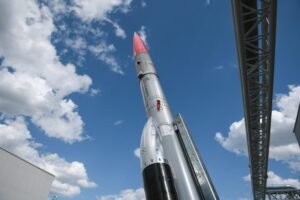
Rocket technology is another area of Polish innovation. In July 2024, the ILR-33 Bursztyn 2K rocket, developed by engineers at the Łukasiewicz Institute of Aviation, successfully reached space. POLSA provided financial and organisational support for the project. The achievement demonstrated the capabilities of Polish engineers and research institutions in advanced propulsion and launch technologies.
Poland is also investing in research and innovation connected with future space exploration. POLSA works to bring together universities, companies and public institutions, supports the development of new space technologies and helps Polish organisations gain flight heritage and experience through participation in missions. The agency also works on international scientific and technological projects and supports Polish participation in large-scale European and global programmes.
A major milestone for Poland was the IGNIS mission to the International Space Station in 2025. Polish ESA project astronaut Sławosz Uznański-Wiśniewski participated in Axiom Mission 4 (Ax-4), marking Poland’s return to human spaceflight after more than four decades. The IGNIS mission included 13 scientific and technological experiments developed by Polish institutions. The experiments covered areas including materials, biology, medicine and advanced technologies, demonstrating the connection between human spaceflight and Poland’s scientific and industrial capabilities.
The IGNIS mission also created a particularly important connection between Poland and India. Ax-4 carried astronauts from India, Poland and Hungary to the International Space Station, alongside NASA and Axiom Space participation. India’s pilot was Shubhanshu Shukla, who works with the Indian Space Research Organisation (ISRO), while Poland was represented by Sławosz Uznański-Wiśniewski. ISRO’s Project Director Sudeesh Balan and POLSA representatives were also involved in the mission’s preparation and coordination.
This was an important example of how Poland and India can work within wider international space programmes. The cooperation took place through the multinational Ax-4 mission involving ISRO, ESA, NASA and Axiom Space, rather than through a separately announced POLSA–ISRO bilateral mission. Poland and India therefore shared a direct human-spaceflight connection through the same ISS mission. The experience created opportunities for scientific exchange, technological cooperation and stronger relationships between the two countries’ growing space ecosystems.
There is also a wider institutional connection between Poland and India through international space cooperation. POLSA and ISRO participate in the International Space Exploration Coordination Group (ISECG), a forum where space agencies coordinate exploration-related activities and discuss opportunities for international cooperation. Both countries therefore contribute to the wider global community working on future space exploration.
India’s space ecosystem provides another potential area for cooperation because India’s reforms have opened greater opportunities for private companies alongside ISRO. India’s IN-SPACe acts as a single-window agency supporting and authorising private-sector participation in space activities, including satellite and launch-vehicle development and the use of space infrastructure. This creates possibilities for international companies and institutions to connect with India’s expanding commercial space ecosystem.
Poland is also strengthening the internationalisation of its private space sector. In 2025, POLSA, with support from Poland’s Ministry of Development and Technology, launched the Brand HUB initiative to promote Polish aerospace SMEs internationally. The programme supports Polish companies through international trade events, national stands and business meetings. POLSA’s participation at the International Astronautical Congress has provided Polish companies with opportunities to meet international space agencies, investors, technology companies and potential partners.
The future of Poland’s space sector is therefore closely connected with international partnerships, advanced research and private-sector innovation. Poland’s growing network of companies, universities and research institutes provides a strong foundation for participation in satellite missions, Earth observation, robotics, artificial intelligence, telecommunications and exploration programmes. Its membership of ESA and participation in international missions further connects Polish organisations with the global space economy.