

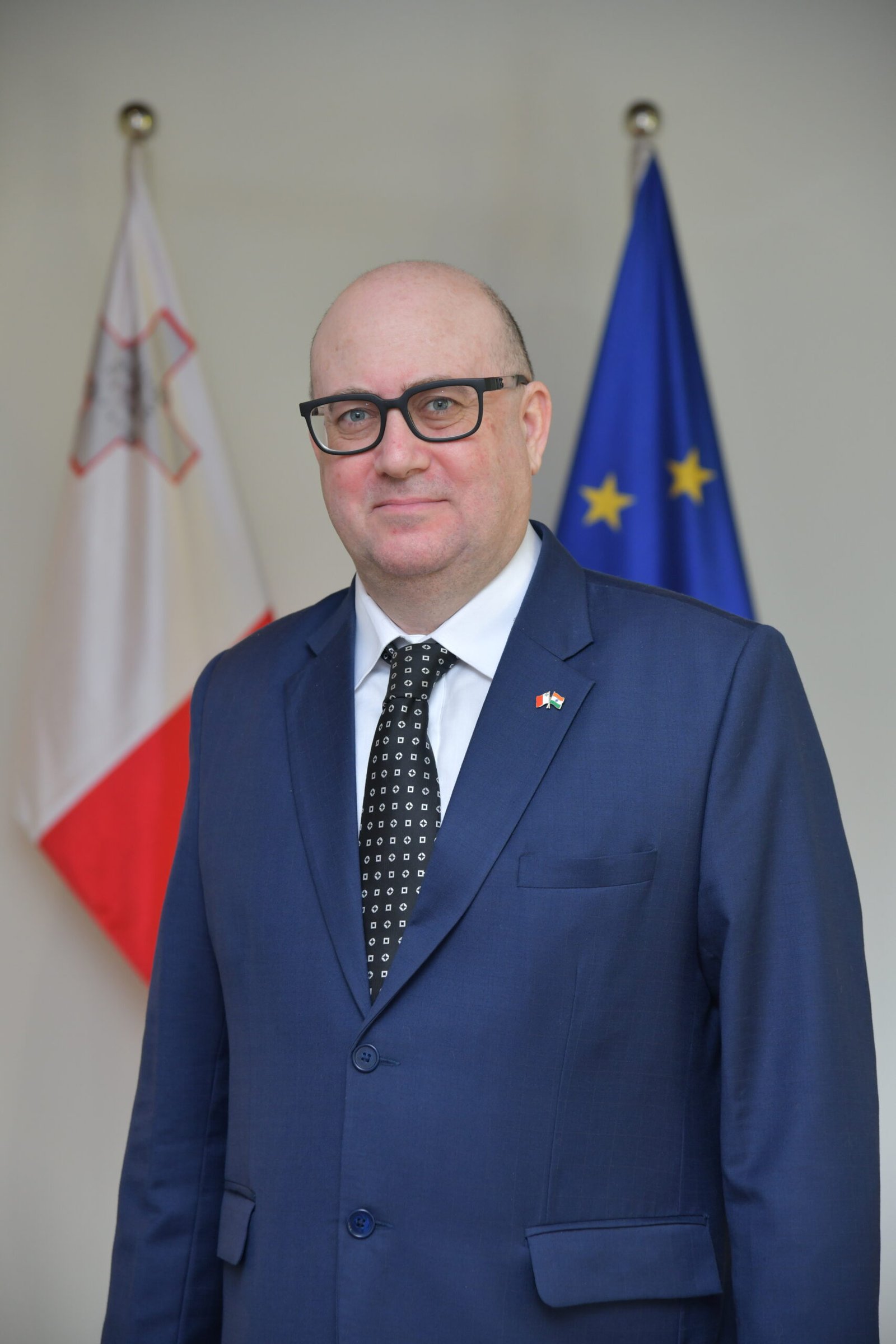
“One of Malta’s greatest advantages is the
diversity of experiences it offers despite its small size.”
Malta and India share warm and friendly relations. How would you describe the present state of India–Malta relations, and which areas of cooperation do you think are growing the fastest today?
India and Malta enjoy a very warm and longstanding relationship. In 2025, we celebrated sixty years of diplomatic relations. As I often like to point out, India was among the first countries to recognize Malta’s independence. Malta became independent on 21 September 1964, and less than six months later, on 10 March 1965, India formally recognized Malta. Today, our diplomatic relationship is sixty-one years old, and I still like to say that we are only at the beginning of what can be achieved together.
We cooperate across a number of important sectors, including pharmaceuticals, finance, tourism, education, and the film industry. We are also keen to attract greater Indian investment into Malta. The ongoing India–EU Free Trade Agreement negotiations represent an important opportunity to deepen trade and investment ties between India and Europe.
The pharmaceutical sector is a particularly successful example of our cooperation. Indian companies such as Aurobindo Pharma, Torrent Pharmaceuticals, and Misom Labs have operations in Malta. Products manufactured in India are tested and certified in Malta and can subsequently access the wider European Union market. Tourism is another important area of engagement, accounting for approximately 35 per cent of Malta’s economy. We look forward to welcoming more visitors from India and further strengthening people-to-people ties
Malta has strongly supported the ongoing India–EU Free Trade Agreement negotiations and has positioned itself as a strategic gateway to Europe. How can Malta access European markets more effectively, and what opportunities do you foresee for boosting bilateral trade and investment once the India–EU trade deal is concluded?
Malta may be a small country, but it possesses several advantages that make it an attractive destination for Indian businesses. Both Malta and India are members of the Commonwealth and share a strong tradition of English-language communication, which facilitates business and commercial engagement.
Malta is also home to a growing Indian workforce whose contribution to our economy we value greatly. Most importantly, investing in Malta effectively means investing in the European Union. As a member state of the EU, Malta provides access to a market of nearly 450 million consumers.
The pharmaceutical sector illustrates this particularly well. Products manufactured in India and tested or certified in Malta can be marketed throughout the European Union. Similar opportunities exist in sectors such as semiconductors, technology, financial services, and specialized services. Malta can therefore serve as a practical gateway and steppingstone for Indian companies seeking to expand into Europe.
During Deputy Prime Minister and Foreign Minister Ian Borg’s meeting with India’s External Affairs Minister, Dr. S. Jaishankar, on the sidelines of the Raisina Dialogue, discussions covered multi-sector cooperation. Which areas do you believe hold the greatest potential for delivering concrete outcomes in the coming years, and what steps are being taken to translate these discussions into action?
The meeting between Dr. Ian Borg and Dr. S. Jaishankar was highly productive and reflected the importance both countries attach to this relationship. The discussions covered global developments, bilateral cooperation, and a number of agreements and initiatives that continue to be explored.
Since then, on 30 May 2026, Malta has undergone a General Election, in which the ruling Labour Party won again with a comfortable majority. A cabinet reshuffle took place and Hon Dr. Ian Borg continues to serve as Deputy Prime Minister and is now Minister for Health, while the Hon. Dr. Chris Fearne has assumed responsibility for Foreign and European Affairs.
Looking ahead, I see considerable opportunities in pharmaceuticals, information technology, semiconductors, film production, trade, and investment. Both Malta and India are stable democracies operating in an increasingly uncertain international environment. Stability, democracy, and the rule of law provide a strong foundation for long-term cooperation and economic growth. I am confident that our partnership will continue to expand across a range of sectors in the years ahead.
The Speaker of the House of Representatives of Malta, H.E. Mr. Anglu Farrugia, visited India in January 2026. What were the key outcomes of this visit, and how will it strengthen bilateral ties?
The visit of H.E. Mr. Anglu Farrugia was very successful and contributed significantly to strengthening parliamentary and institutional contacts between Malta and India. It provided an opportunity to engage with counterparts from India and other countries and further deepen mutual understanding.
Speaker Farrugia was particularly impressed by the functioning of India’s democratic institutions and by the scale of the Indian Parliament, which represents the world’s largest democracy. Such exchanges play an important role in reinforcing bilateral relations and creating lasting connections between institutions and people.
Malta is known for its rich cultural traditions, including music, festivals, and wines. How do these cultural elements help promote Malta globally and attract international visitors?
Culture is one of Malta’s greatest assets and plays an important role in promoting our country internationally. Visitors are drawn to Malta’s history, architecture, traditions, cuisine, festivals, and wines, all of which form part of our national identity.
Recently, we have seen Maltese products entering the Indian market, including Marsovin wines, Maltese food products, beverages, and other culinary offerings. These help introduce Indian consumers to Malta’s culture and heritage.
Tourism often serves as the first step towards broader engagement. Many visitors discover Malta as tourists and later return as investors, students, or business partners. In this way, cultural diplomacy and tourism contribute directly to economic cooperation and stronger international relationships.
Tourism is an important bridge between nations. What are the must-visit places and unique experiences you would recommend to Indian tourists planning a trip to Malta?
One of Malta’s greatest advantages is the diversity of experiences it offers despite its small size. Visitors can explore Valletta, our historic capital city; Mdina, the ancient walled city; and the Three Cities, each of which reflects Malta’s rich history and cultural heritage.
Malta is also renowned for scuba diving, coastal tourism, Mediterranean cuisine, and a vibrant cultural scene. Our unique blend of European and Mediterranean influences is reflected in our architecture, language, and traditions.
Film tourism is another growing attraction. Many internationally acclaimed productions, including Gladiator, Gladiator II, Troy, and Munich, were filmed in Malta. Several Bollywood productions have also chosen Malta as a filming destination, attracting Indian visitors who wish to explore these locations firsthand.
Destination weddings have become a major segment of global tourism, and Indian couples are increasingly choosing international locations for their celebrations. Do you see Malta emerging as a preferred destination for Indian weddings, and what facilities does the country offer to host such events?
Certainly. Malta has already hosted a number of Indian weddings, and we would be pleased to welcome more in the future. Destination weddings represent an important segment of the tourism industry, which today encompasses a wide range of activities, including educational, cultural, religious, health, and wellness tourism.
Given India’s large population and growing international travel market, there is significant potential to further strengthen tourism links between our two countries across multiple sectors. With regard to destination weddings, Malta offers excellent infrastructure and a wide variety of venues. The country has a strong hospitality sector, with numerous hotels and restaurants capable of hosting international wedding celebrations. In addition, Malta’s rich historical heritage provides unique venues, including historic sites and landmarks that can be used for special events.
Although Malta is a relatively small country, it offers a remarkable diversity of experiences and attractions. Visitors can enjoy a combination of history, culture, hospitality, and scenic beauty, making Malta an attractive destination for weddings and other special occasions.
During your tenure here in India, how do you see India–Malta cooperation in education? Education is also an important component of trade, whether through Indian students studying abroad or through educational tourism. Malta is well known in this field.
Education is an important pillar of India–Malta cooperation and, in many ways, also a form of tourism. During my six years in India, I have witnessed growing interest in Malta among Indian students, as well as increasing engagement from Maltese institutions such as the University of Malta, MCAST, and several private colleges.
Malta is also well known for its English-language teaching sector, attracting students from across Europe and beyond. However, Indian students generally choose Malta for higher education and professional programmes rather than language courses, given the widespread use of English in India.
We have seen a steady rise in the number of Indian students pursuing studies in fields such as nursing, management, information technology, and other professional disciplines. Over the years, this trend has flourished considerably, reflecting the strong educational links between our two countries.
I hope this momentum will continue, with more talented Indian students choosing Malta as a destination for quality education and professional development. Indian medical professionals are also highly regarded in Malta, further strengthening the people-to-people ties between our nations.
Malta recently witnessed a change in its foreign policy leadership with the appointment of Mr. Chris Fearneas the newMinister for Foreign and European Affairs. How do you view his experience and leadership credentials, and what implications do you foresee for the future of India–Malta relations? Additionally, are there any plans for a high-level visit to India in the near future?
While Malta has a new Foreign Minister following the recent government reshuffle, there is a strong element of continuity in governance, as the Labour Party continues to hold power with a decisive parliamentary majority following its electoral victory.
Hon. Chris Fearnebrings considerable experience to the role. He previously served as Deputy Prime Minister and Health Minister, where he was widely recognized for his leadership during the COVID-19 pandemic. A medical doctor and surgeon by profession, he is known for his intellectual depth, professionalism, and meticulous approach to policymaking. These qualities will undoubtedly serve him well in his new responsibilities.
With regard to India, I am confident that he will take a keen interest in further strengthening our bilateral relationship. Malta greatly values its partnership with India, and I believe there are significant opportunities to deepen cooperation across a range of sectors.
As for a visit to India, it is still too early to make any announcements. We have recently seen important high-level exchanges between our two countries, and no specific plans have been confirmed at this stage. Nevertheless, we would welcome future visits at the ministerial or leadership level, whether by Maltese dignitaries to India or Indian leaders to Malta. What remains certain is that the new Foreign Minister recognizes the importance of India on the global stage and will be committed to advancing the strong and friendly relations that exist between our two countries.
Would you like to give any message to our Envoy Excellency readers?
Serving in India for the past six years has been a wonderful experience. India has become a second home to me. During my time here, I have witnessed the warmth, hospitality, and dynamism of the Indian people, as well as the valuable contribution made by the Indian community in Malta, particularly in sectors such as healthcare and services.
India represents one-sixth of humanity and plays an increasingly important role on the global stage. It is a country of immense talent, energy, and opportunity. I wish the people of India continued prosperity and success, and I remain confident that the friendship between Malta and India will continue to grow stronger in the years ahead.