

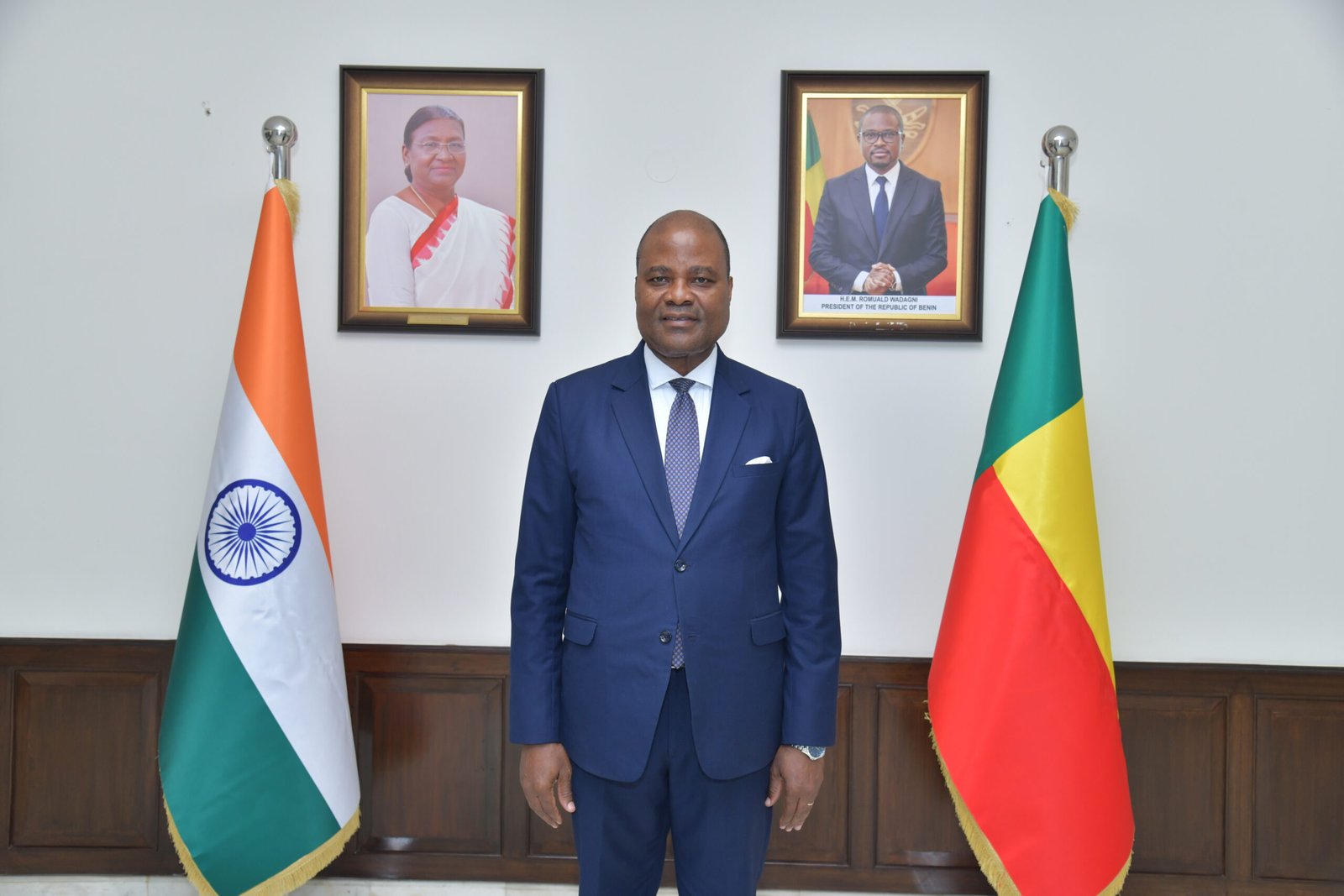
“Benin and India enjoy longstanding, warm and friendly relations built on mutual
respect, solidarity and shared development priorities.”
Benin and India have shared warm and friendly relations over the years, supported by growing cooperation in trade, development, capacity building, and people-to-people exchanges. How do you assess the current state of India-Benin relations, and what areas offer the greatest potential for expanding this partnership in the coming years?
The current state of our relations is very positive. India is one of Benin’s most important partners, and our cooperation covers trade, development financing, agriculture, water, rural electrification, health, education, digital technology, culture, capacity building, security and defence. Bilateral trade reached USD 1.34 billion in 2022-2023.
The greatest potential for expansion lies in moving from trade to investment and industrial partnership. Benin is looking for stronger cooperation in agro-processing, pharmaceuticals, information technology, digital public infrastructure, renewable energy, textile and garments, education, skills development, defence and security, and industrialization. Our ambition is to transform our excellent political relationship into a deeper economic, technological and human partnership.
Benin is increasingly emerging as one of West Africa’s most promising investment destinations, with its strategic location, improving infrastructure, and business-friendly reforms. What specific investment opportunities would you like to highlight for Indian investors, and why should India look at Benin as a preferred destination for business expansion in Africa?
Benin offers Indian investors a stable, reform-oriented and business-friendly environment. The country has strengthened governance, improved the investment climate, modernized infrastructure and positioned itself as a gateway to West Africa. Benin’s location gives investors access not only to its national market, but also to wider regional opportunities in West African countries.
A major investment opportunity is the Glo-Djigbé Industrial Zone, 1,640 acres integrated industrial platform designed to accelerate local processing, industrial production and exports. This zone supports Benin’s strategic ambition to move from the export of raw materials to local transformation, job creation and value addition. It is particularly relevant for Indian companies in textiles and garments, cotton processing, cashew processing, soybean transformation, pharmaceuticals, light manufacturing, logistics, packaging and industrial services.
Benin also offers opportunities in agriculture and agro-industry, renewable energy, especially solar power, healthcare, digital services, education, infrastructure and tourism. India should look at Benin as a preferred destination because the country combines political stability, strong reforms, a growing industrial base, a strategic coastal position and a clear government vision focused on transformation, employment and regional integration.
Indian companies have built a strong presence across Africa in sectors such as agriculture, pharmaceuticals, information technology, renewable energy, manufacturing, and infrastructure development. Which sectors in Benin are most attractive for Indian companies, and what kind of partnerships would your government like to see develop between Indian and Beninese businesses?
The sectors most attractive for Indian companies are agriculture and agro-processing, pharmaceuticals and healthcare, information technology, renewable energy, manufacturing, infrastructure, textiles, education and vocational training. These sectors correspond closely to Benin’s development priorities and to India’s proven strengths in Africa and globally.
In agriculture, Benin offers opportunities in cotton, cashew, soybean, rice, shea, agricultural machinery, irrigation, storage, logistics and food processing. In pharmaceuticals, India’s capacity to produce affordable medicines and medical technologies can help strengthen Benin’s healthcare ecosystem. In digital technology, India’s experience in digital public infrastructure, e-governance, artificial intelligence and innovation can support Benin’s digital transformation. In renewable energy, solar solutions are particularly relevant, given Benin’s energy needs and its participation in International Solar Alliance (ISA) cooperation.
Benin would like to see partnerships that go beyond import-export. We are looking for joint ventures, local manufacturing, industrial investment, technology transfer, training of Beninese workers and integration of local companies into regional and global value chains. The aim is to create mutually beneficial partnerships in which Indian companies use Benin as a competitive platform in West Africa, while Benin benefits from jobs, skills, technology and industrial transformation.
Benin is known for its rich cultural heritage, historical significance, vibrant traditions, and unique tourism destinations. For Indian travelers who may not yet be familiar with the country, what are some of the must- visit attractions and experiences that showcase the true spirit and identity of Benin?
Benin is a land of history, memory, culture and hospitality. For Indian travelers, the country offers an authentic African experience that combines heritage, spirituality, nature and modern creativity. One of the most visible symbols of national pride is the Amazon Monument in Cotonou. This impressive 30-metre-high monument pays tribute to the legendary women warriors of the former Kingdom of Dahomey, known for their courage, discipline and contribution to Benin’s historical identity.
Visitors should also discover Ouidah, one of the most important historical cities in West Africa. Ouidah offers the Route of Slaves, the Door of No Return, the Python Temple, museums and cultural sites that speak to memory, spirituality and heritage. Please don’t miss The Vodun Days Festival in Ouidah. The event takes place from January 8 to 10 evey year and feature a variety of activities, cultural shows and open-air concerts.
The Royal Palaces of Abomey, listed as a UNESCO World Heritage Site, provide a deep understanding of the history of the Kingdom of Dahomey. Ganvié, often called the “Venice of Africa”, is another exceptional destination, with its lake village and unique way of life.
Benin also offers beautiful coastal landscapes, traditional festivals, craft markets, rich music and dance traditions, and natural attractions such as Pendjari National Park. For Indian travelers, Benin is not only a country to visit; it is a country to experience through its history, traditions, cuisine, art, spirituality and warm hospitality.
Tourism and business travel often play a vital role in strengthening bilateral ties. What measures has the Government of Benin taken to facilitate travel for Indian tourists, entrepreneurs, and investors, and are there any plans to further improve visa services and travel connectivity between our two countries?
Benin has taken concrete measures to facilitate travel for tourists, entrepreneurs and investors. One of the most practical measures is the availability of Benin’s visa online through the official e-visa platform. This enables foreign travelers, including Indian visitors, to submit applications online, follow the process and receive the visa electronically. This is an important facilitation measure for tourism, business missions, investment prospecting and academic exchanges.
Going forward, we would like to see stronger air connectivity between India and West Africa, more business delegations, more tourism promotion and closer cooperation among travel agencies, chambers of commerce and investment promotion institutions. Mobility is an essential driver of bilateral cooperation, because every visit can become a business opportunity, an academic partnership, a tourism experience or a cultural bridge.
Beyond trade and investment, cultural exchanges and educational cooperation are increasingly important in international relations. How can India and Benin strengthen people-to-people contacts, academic partnerships, and cultural engagement to deepen mutual understanding between our societies?
People-to-people relations are central to the future of India-Benin cooperation. Education and capacity building already constitute strong pillars of our partnership. Each year, the Indian Council for Cultural Relations offers between 5 and 10 scholarships to Beninese students for undergraduate and postgraduate studies in India. In addition, the Indian Technical and Economic Cooperation Programme provides training opportunities for Beninese officials, professionals, diplomats, military personnel and technical experts.
There are also new opportunities under discussion with Indian institutions. These include a prospective partnership with Indian Institutes and Universities for scholarships for Beninese candidates. These initiatives can help train young Beninese in strategic areas such as engineering, medicine, digital technology, management, agriculture, artificial intelligence and applied sciences.
Cultural cooperation is also important. Benin and India are two countries with strong traditions, spiritual depth and rich artistic expressions. We should encourage cultural festivals, music and dance exchanges, exhibitions, film cooperation, university partnerships, tourism promotion and research on our societies. These exchanges will deepen mutual understanding and bring our peoples closer together.
High-level visits often provide fresh momentum to bilateral cooperation. Could you share any information regarding upcoming ministerial, parliamentary, or high-level exchanges between Benin and India, and what outcomes would you hope to see from these engagements?
High-level exchanges have always played a decisive role in giving momentum to India-Benin relations. The 2019 State Visit of President Ram Nath Kovind to Benin has ended by the announcement of concessional line of credit and the signing of four agreements and memorandums of understanding.
Looking ahead, Benin attaches particular importance to the next India-Africa Forum Summit. This Summit is a strategic platform to renew India’s engagement with Africa and to give visibility to Benin’s priorities in trade, investment, industrialization, digital transformation, agriculture, health, education, renewable energy, security and capacity building. Benin’s participation would also support the strengthening of both the bilateral relationship and the wider India-Africa partnership.
At the bilateral level, the expected next steps include the organization of the second session of the Benin-India Joint Commission, the continuation of political and diplomatic consultations and the preparation of future high-level visits. We hope these engagements will lead to concrete results. We also hope to organize “Invest in Benin” forums in New Delhi and to mobilize more Indian companies to invest in Benin.
Would you like to give any message to our Envoy Excellency readers?
My message to the readers of Envoy Excellency is that Benin is open, ambitious and ready for a new phase of partnership with India. Under the leadership of President Romuald Wadagni, the new Government’s priorities include continuity in economic reforms, better living standards for citizens, job creation, improved access to basic services, social protection, modernization of public administration, agricultural transformation, digital innovation, regional cooperation and the strengthening of domestic security in the face of threats from the Sahel.
These priorities create a natural space for stronger India-Benin cooperation. Benin offers stability, reform momentum, a strategic location in West Africa, an expanding industrial base and a clear determination to transform its economy.The foundation is already strong. I therefore invite Indian investors, entrepreneurs, universities, cultural institutions, tourists and young innovators to look at Benin as a reliable partner, a country of opportunity and a gateway to West Africa. Benin and India share a common belief in development,
innovation and South-South cooperation. Together, we can build a partnership that creates value, jobs, knowledge and prosperity for our peoples.