

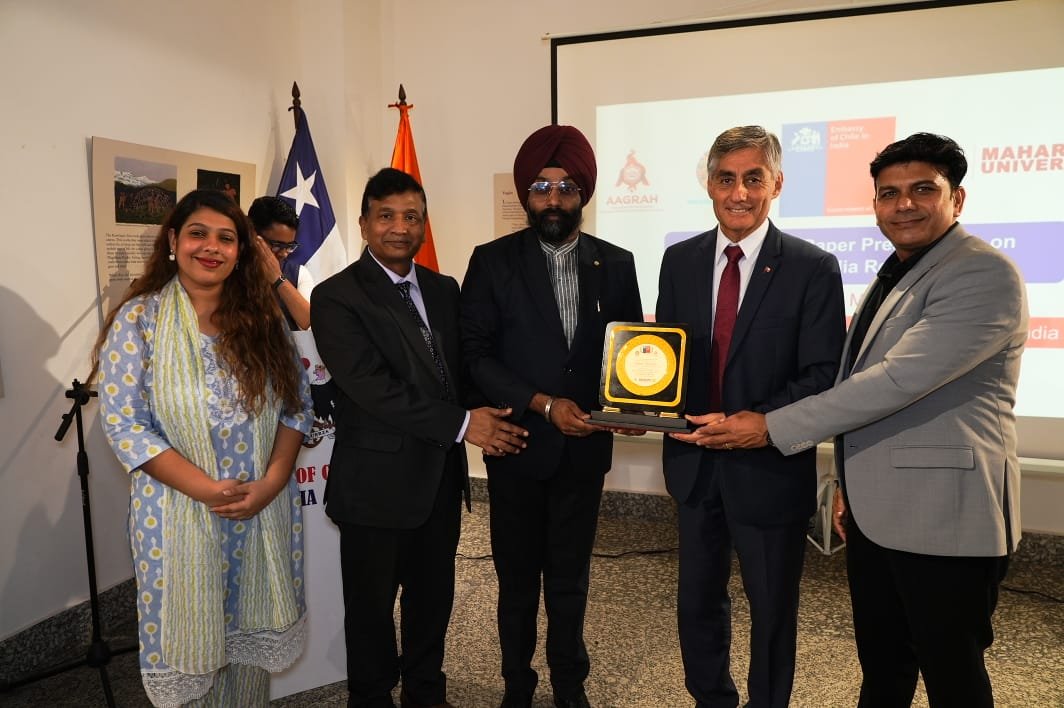
New Delhi – 15 July 2026: AAGRAH and World Cultures Hub Forum, in partnership with the Embassy of Chile in New Delhi, hosted a Research Paper Presentation Session on India-Chile relations. The event brought together diplomats, academics, policy researchers, and a cohort of young scholars to examine the evolving dimensions of the bilateral relationship across trade, critical minerals, technology, culture, and people-to-people connectivity.
The session convened from 3:30 PM to 5:30 PM and was designed to give emerging researchers a platform to present original work on issues central to India–Chile engagement, with each presentation followed by structured discussion and feedback from senior academics and diplomatic representatives.
The programme opened with a welcome address. H.E. Juan Angulo, Ambassador of Chile to India, delivered opening remarks, highlighting the strategic importance of deepening bilateral cooperation beyond traditional trade ties and underscoring the role of youth-led research in informing policy priorities. 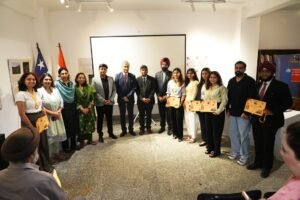
Professor Priti Singh and Professor Aprajita Kashyap from Jawaharlal Nehru University (JNU), delivered special remarks, emphasising the academic and policy relevance of the research presented and the importance of institutional partnerships in nurturing research capacity among young scholars.
Six original research papers were presented, each addressing a distinct but interconnected facet of India–Chile relations:
1. India–Chile CEPA Negotiations (2025): From Preferential Trade to Comprehensive Partnership The paper examined the structural gaps in the existing Preferential Trade Agreement and analysed how a proposed Comprehensive Economic Partnership Agreement (CEPA) could reorient bilateral trade from primary commodities to diversified, higher-value exchange.
2. Critical Minerals and Lithium Security: Strategic Resource Diplomacy between India and Chile This study explored how cooperation with Chile on lithium and critical minerals could secure India’s supply chains while enabling movement up the value chain, with attention to green-transition priorities and long-term resource diplomacy.
3. Digital Public Infrastructure and Innovation Diplomacy: Building Technology Partnerships
The paper assessed how India’s experience with Digital Public Infrastructure could be adapted through bilateral cooperation to strengthen Chile’s digital governance and foster joint innovation ecosystems.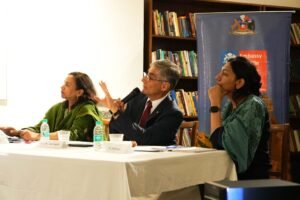
4. Audiovisual Cooperation and Film Diplomacy: Cultural Economy as Strategic Engagement The study considered whether audiovisual cooperation—co-productions, production incentives, and film-commission partnerships—can function as a strategic tool to advance economic, tourism, and soft-power objectives in India–Chile relations.
5. Diaspora, Educational Exchange, and People-to-People Connectivity: Institutionalising Social Foundations The paper analysed how nascent diaspora links and growing educational exchanges between India and Chile could be converted into sustained institutional platforms for cooperation beyond state-centric channels.
6. Cultural Exchange Programme (2025): Evaluating Cultural Diplomacy’s Outcomes and Instruments This research presented a framework for operationalising the 2025 Cultural Exchange Programme with measurable indicators, so that cultural diplomacy can demonstrably contribute to mutual understanding and shared policy goals.
Certificates were distributed to all paper presenters by Ambassador Juan Angulo, recognising their contribution to the discourse on bilateral cooperation. The programme concluded with a networking session and high tea.