

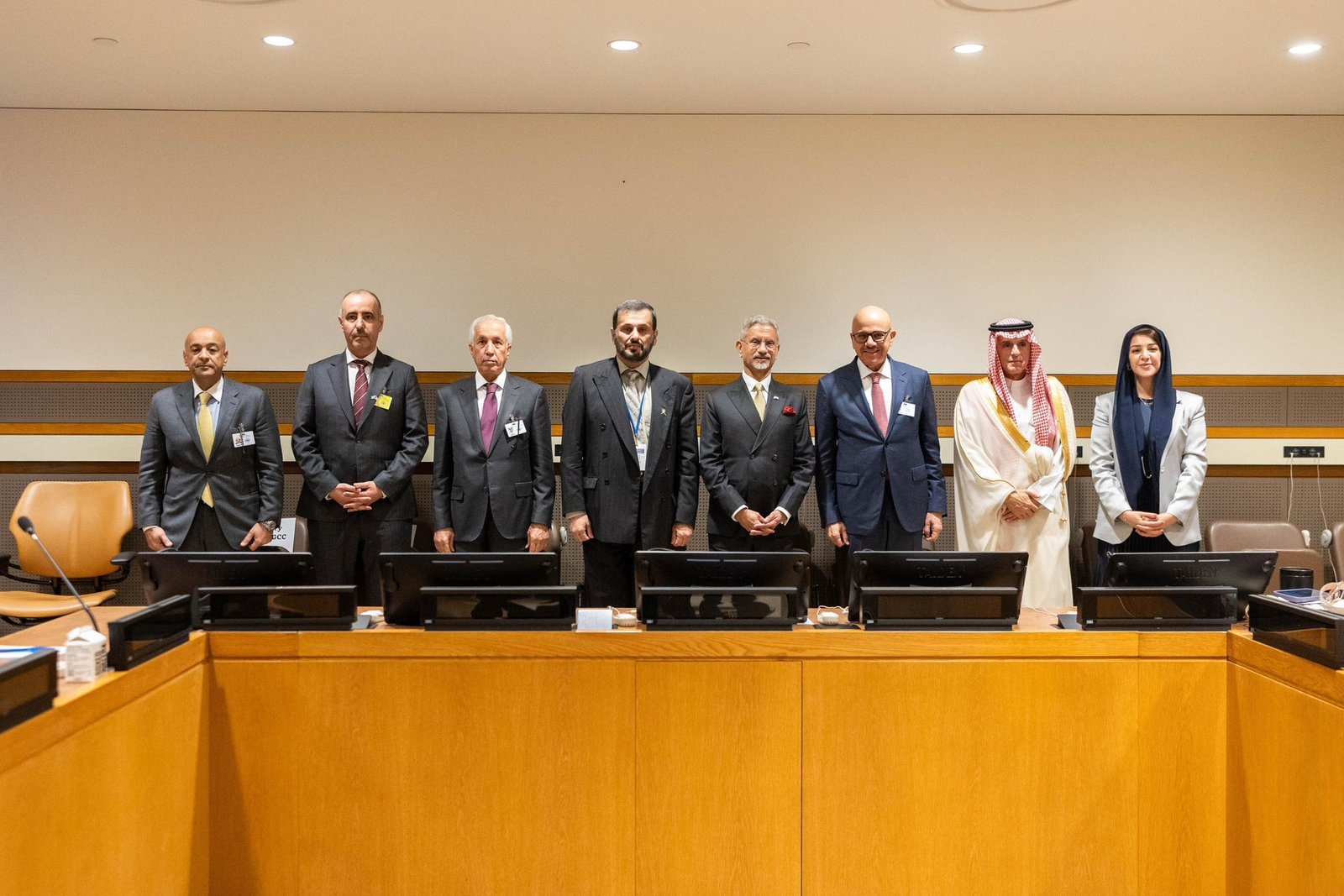
India-Gulf Cooperation Council (GCC) Troika Ministerial Meeting was held today on the margins of the 81st session of the United Nations General Assembly in New York. External Affairs Minister, Dr. S. Jaishankar, led the Indian delegation. The GCC was represented at the Troika-level by H.E. Dr. Abdullatif bin Rashid Al Zayani, Minister of Foreign Affairs, Bahrain; H.E. Jasem Mohamed Albudaiwi, Secretary General of GCC and H.E. Adel Al-Jubeir, Minister of State for Foreign Affairs, Kingdom of Saudi Arabia. Her Excellency Reem Al Hashimy, Minister of State for International Cooperation of UAE, HE Sultan Al Muraikhi, Minister of State for Foreign Affairs of Qatar, HE Ambassador Mohammed bin Abdullah Al Qutbi, Director of the Department of Organizations, MoFA, Oman and HE Ambassador Hamad Al Marii, Assistant Minister for Foreign Affairs of Kuwait also participated in the meeting.
The leaders reaffirmed their joint commitment to building on the achievements of the first India-GCC Joint Ministerial Meeting for Strategic Dialogue held on September 09, 2024 in Riyadh. EAM highlighted that India and GCC countries share historically close and friendly ties, underpinned by vibrant trade linkages and strong people-to-people ties. In recent years, the relationship between India and GCC countries has deepened in various spheres including trade, investment, energy, health, technology and cultural exchanges. A large Indian diaspora resides in the GCC region. Trade & Investment between India and GCC continues to grow with total trade of USD 178.66 billion in FY 2025-26.
The leaders reviewed the implementation of the India-GCC Joint Action Plan (JAP) 2024-2028, which was adopted at the first India-GCC Joint Ministerial Meeting for Strategic Dialogue. The JAP envisages joint activities in areas such as political dialogue, security, trade & investment, agriculture & food security, transportation, energy, health, culture, and education. They underlined that the diversity of sectors in the JAP represented the depth and breadth of engagements between India and GCC countries and appreciated the steady progress in advancing cooperation in these sectors.
The leaders welcomed the launch of India-GCC Free Trade Agreement (FTA) negotiations after finalizing the Terms of Reference (ToR) in February 2026. They noted that the FTA is expected to unlock the full potential of trade between India and the GCC upon signing and would be a force multiplier for global good, while facilitating the expansion and diversification of exports and strengthening economic integration between the two sides.
EAM thanked GCC countries for the energy and fertilizer supplied despite the disruption of trade routes in the recent conflict in West Asia. EAM also emphasized further strengthening India-GCC energy partnership including by expanding cooperation in the field of renewables, biofuels, and green technologies.
The leaders emphasized the importance of strengthening people-to-people linkages through joint activities in the field of arts, heritage, yoga, music, cinema, and literature. EAM appreciated the GCC countries for ensuring the welfare of the Indian diaspora, and for their safety and well-being during the recent West Asia conflict.
The leaders also exchanged views on regional and international issues of mutual concern. Discussions were held on the situation in West Asia, challenges to commercial shipping in international waterways, support for reform of multilateral institutions, and tackling contemporary challenges such as sustainability and terrorism. EAM highlighted the importance of regional peace and security, and efforts to use dialogue and diplomacy to resolve conflicts.
Both sides agreed to hold the second edition of India-GCC Joint Ministerial Meeting for Strategic Dialogue at an early date.