

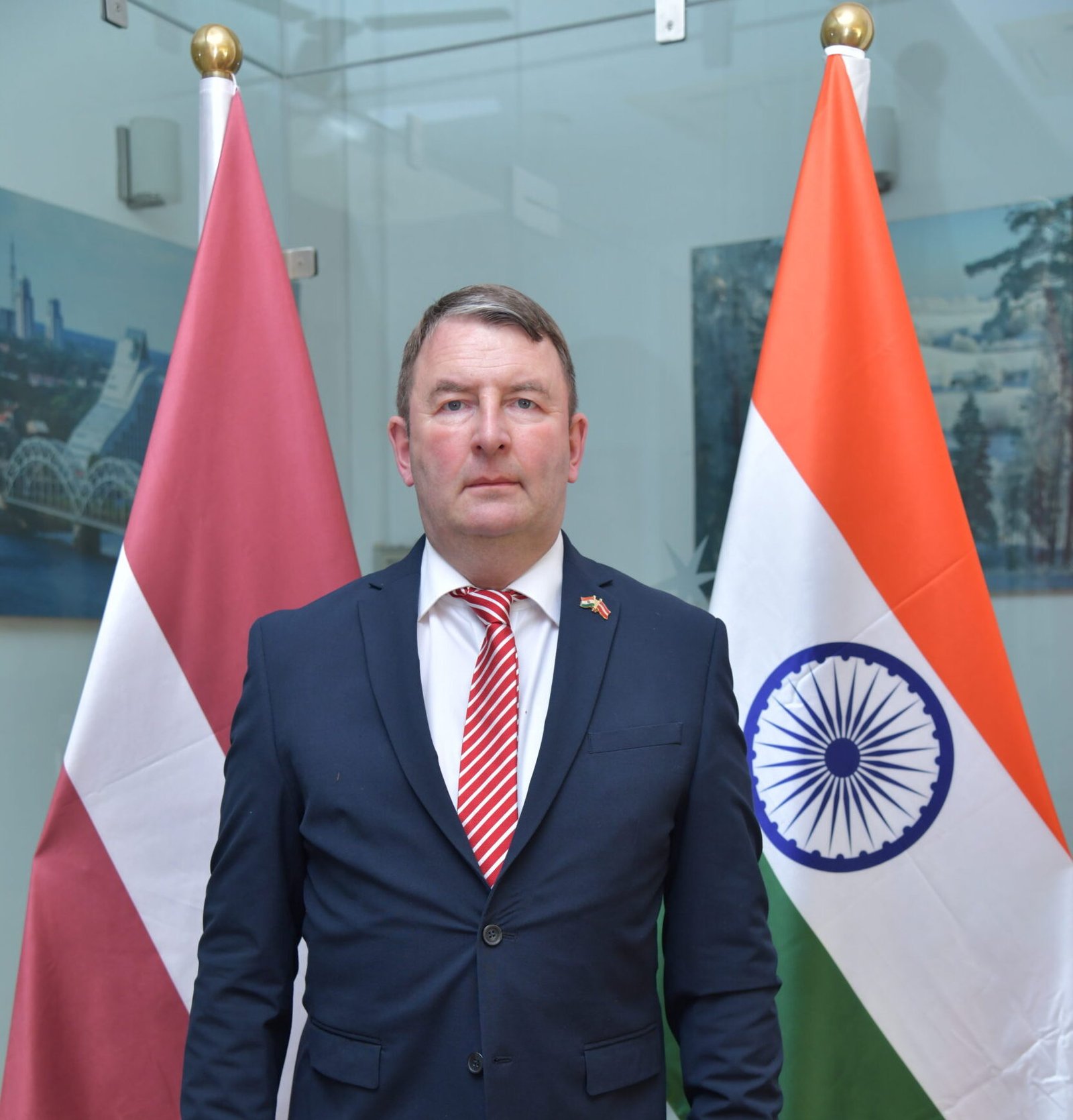
“Latvia is located at the heart of the Baltics, and we share strong relations with
our neighboring countries. Latvia offers a unique and refreshing experience.”
As Latvia and India mark the 35th anniversary of diplomatic relations, how would you describe the evolution of bilateral ties over the years?
The relations between Latvia and India have evolved in a gradual and steady manner since Latvia regained its independence. Initially, engagement was conducted through the accreditation of non-resident ambassadors. Over time, this relationship developed further with the establishment of resident embassies in both capitals. Latvia established its embassy in New Delhi in 2014 while India opened its embassy in Riga in 2024, I currently serve as the third resident Ambassador of Latvia to India. This steady progression reflects the deepening and strengthening of bilateral ties.
How do you view the recent visit of the Latvian Minister for Smart Administration and Regional Development Mr. Raimonds Čudars to India for the AI Impact Summit 2026, and its impact on bilateral ties?
First of all, I would like to express my gratitude to the Government of India and Prime Minister Narendra Modi for inviting Latvia to participate in the Artificial Intelligence Summit in New Delhi. The Government of Latvia was represented by the Minister for Smart Administration and Regional Development. This participation was an important step for Latvia, as we have consistently been active participants in global AI summits, including previous editions such as the one held in Paris. In the framework of the Delshi summit Latvia as OECD member state participated in the Council Meeting of Global Partnership of Artificial Intelligence to promote human-centric, safe, secure, and trustworthy AI, grounded in the OECD Recommendation on AI. AI summit hosted by India provided a valuable opportunity, and Latvia’s participation contributed positively to strengthening bilateral relations.
As a leading Baltic country, what are Latvia’s strengths in technology, innovation, and economic development that could interest Indian partners?
My message to Indian entrepreneurs is to take a closer look at Latvia. While Latvian companies may not yet have globally recognized brand names, they are highly innovative and operate in niche areas. Most companies in the IT and technology sectors are small in size but offer highly specialized solutions. Many of them began as startups and have developed rapidly. For example, Latvia has emerging capabilities in the space industry.
During a recent visit by our Foreign Minister to India, a delegation of Latvian companies—though small in size—presented ambitious and innovative solutions. In a meeting at ISRO in Bengaluru, one company introduced a unique technology using isotopes as a source of energy and heat for lunar exploration. This demonstrates Latvia’s capacity to contribute cutting-edge solutions in advanced sectors.
How do you see EU–India trade agreements contributing to enhanced economic engagement between Latvia and India?
The EU–India trade agreement has the potential to significantly advance economic cooperation. For companies on both sides that already have established partnerships, it would elevate trade to the next level by increasing volumes. For Latvian companies—many of which are small and medium-sized enterprises and not yet present in the Indian market—this agreement represents an important opportunity. It can help businesses from both sides discover each other more effectively. At present, there are both real and perceived barriers that hinder engagement. Despite the availability of information in today’s digital world, personal experience and direct interaction remain crucial. I believe that once implemented, this agreement will serve as an important impetus for strengthening economic ties.
How important have high-level visits been in strengthening Latvia–India relations, and what more can be done in this regard?
High-level visits are an integral part of relations between countries. In many ways, they can be compared to personal relationships—without regular interaction, it is difficult to build strong and lasting connections. Such visits act as a catalyst for bilateral engagement, particularly in economic cooperation. In today’s world, where there is an abundance of information and competing priorities, these interactions help both sides remain focused on each other and identify opportunities for collaboration. Even if a visit results in a single successful business agreement, it can be considered a meaningful achievement. Of course, the goal is to achieve multiple mutually beneficial partnerships. This shared objective has been emphasized by both Latvia and India. I recall the address by India’s External Affairs Minister, Dr. S. Jaishankar, at the Nordic and Baltic Business Conclave, where he highlighted the need to accelerate economic cooperation between India and the Baltic region.
What are the key sectors where Latvia sees strong investment opportunities for Indian businesses?
Pharmaceuticals is certainly one of the key sectors, where there is already a foundation for cooperation and potential for concrete joint projects. Several Latvian companies export pharmaceutical products to India, demonstrating existing engagement. Another important sector is biotechnology. I am currently aware of a project under development involving collaboration between an Indian company and Riga Technical University. This example illustrates how academic excellence and business innovation can come together effectively.
The achievements of Latvian scientists in biotechnology have attracted interest from Indian partners, showing that even geographically distant countries can successfully identify and develop meaningful cooperation.
Could you share a success story of Latvian companies in the field of artificial intelligence or advanced technologies?
This is a challenging question, not due to a lack of examples, but because many Latvian innovations are not widely known to the general public. One recent example is a Latvian startup that has developed software solutions for the European Organization for Nuclear Research (CERN), specifically for the selection of suppliers of scientific materials. Another notable example is a Latvian company producing highly specialized, non-reflective glass used to protect valuable artworks, including the Mona Lisa at the Louvre and exhibits at the Rijksmuseum. The company, known as Grog lass, has developed a unique and globally recognized product. Additionally, a company called Aerones has developed robotic technologies for cleaning wind turbine towers and blades, which is particularly relevant for countries like In dia with a growing wind energy sector.
Latvia is known for its rich culture and natural beauty—what destinations would you recommend for Indian tourists visiting Latvia?
I would encourage Indian travelers to explore Latvia with an open mind, as there are meaningful cultural connections despite the geographical distance. There are linguistic similarities between Sanskrit and Latvian, and Indian traditions such as yoga and Ayurveda are widely appreciated in Latvia, making India culturally familiar. Latvia is also home to around 3,000 Indian students, which further strengthens people-to-people connections. From a tourism perspective, Latvia offers a distinct experience through its climate, natural beauty, and peaceful environment. Compared to India’s dynamic energy, Latvia provides a more tranquil and refreshing atmosphere, which can be described as a form of “climate tourism.” The country’s history, nature, and calmness make it an appealing destination for relaxation.
At the same time, cinema presents a strong opportunity to further boost tourism. Bollywood films have a significant influence on travel preferences in India, and Latvia has already been used as a location for international film productions. Recently, a cultural cooperation programme between Latvia and India was concluded, with cinema identified as a key area of collaboration. This opens the door for future Bollywood projects in Latvia, which could significantly enhance its visibility among Indian audiences.
What measures are in place to facilitate visas and ease travel for Indian tourists and business professionals visiting Latvia?
Latvia is part of the Schengen Area, and therefore Schengen visa regulations apply. The process is standardized, and applicants are encouraged to carefully follow the required procedures. For business travelers, having established partners in Latvia can help facilitate the visa process. My key message is simple—adhere to the rules and requirements, and the process will be smooth and efficient.
Would you like to give any message to our Envoy Excellency readers?
My message is simple: I would encourage readers to take a closer look at Northern Europe, particularly the Baltic region. Latvia is located at the heart of the Baltics, and we share strong relations with our neighboring countries in the North and South. At the same time, it is important to understand that each Baltic nation has its own distinct identity. I invite readers to explore and learn about these differences. For Indian travelers—especially seasoned visitors who may have already explored destinations like Paris multiple times—Latvia offers a unique and refreshing experience. I warmly welcome you to discover our country.