


Maltese cinema represents a fascinating and steadily growing part of the cultural identity of Malta. Although the country is small in size, its film industry has developed a distinctive voice and has attracted major international productions thanks to its historical architecture, Mediterranean landscapes, and professional film infrastructure. Over the years, Malta has become known both for producing its own films and for serving as a popular filming location for international cinema, including major Hollywood productions and several films from India.

The roots of Maltese cinema date back to the mid-20th century, when the islands began appearing in international films due to their historic cities, coastal landscapes, and fortifications. Early productions helped introduce Malta to the global film industry and demonstrated the country’s potential as a filming destination. Over time, the Maltese government and the Malta Film Commission supported the development of the local industry by encouraging international productions and providing incentives for filmmakers.
While Malta became known as a filming destination, local filmmakers also began developing their own stories and productions. Early Maltese films focused on themes connected to local culture, maritime traditions, and the island’s social life. These films often used the Maltese language, known as Maltese language, which is unique among European languages because it is a Semitic language written in the Latin alphabet. By producing films in Maltese, directors and writers were able to preserve cultural identity while presenting authentic stories from Maltese society.
One of the most important milestones in Maltese cinema came with the film Simshar released in 2014. Directed by Rebecca Cremona, the film tells a dramatic story inspired by a real maritime incident involving a Maltese fishing family. The film gained international attention and was selected as Malta’s submission for the Best Foreign Language Film category at the Academy Awards, marking the first time Malta had entered a film for Oscar consideration. It later won several international awards, including recognition at the Edmonton International Film Festival and the Mannheim-Heidelberg International Film Festival.
Another major success for Maltese cinema came with the film Luzzu, directed by Alex Camilleri and released in 2021. The film portrays the life of a traditional Maltese fisherman struggling to support his family in a changing economy. Featuring authentic locations and local actors, the film captured global attention when it premiered at the Sundance Film Festival. It was later selected as Malta’s entry for the Best International Feature Film category at the Academy Awards.

Another contemporary production that attracted international interest is Carmen (2021), directed by Valerie Buhagiar. The film explores the life of a Maltese woman who begins a new chapter in her life after years of living in a traditional religious environment. Combining elements of Maltese culture with international storytelling, the film demonstrated the potential of Maltese cinema to appeal to global audiences
Apart from dramatic films, Maltese cinema also includes documentaries and comedies that reflect the island’s unique culture and humor. For example, the documentary Cats of Malta released in 2023 explores the famous street cat communities found throughout the island. The film highlights the role of volunteers and residents who care for stray cats, presenting a charming and distinctive aspect of Maltese life. Comedy films have also been popular among Maltese audiences. Productions such as Klassi Ghalina & The History of the World, released in 2018, built on the success of a well-known Maltese television comedy series and attracted audiences with its humorous take on historical events.
In addition to producing its own films, Malta has become widely recognized as a preferred filming location for international cinema. The country’s scenic landscapes, historic fortresses, and Mediterranean coastline allow filmmakers to recreate different historical settings. As a result, Malta has often been described as a “mini-Hollywood” of the Mediterranean.
Many famous Hollywood films have used Malta as a filming location. One of the most iconic examples is Gladiator directed by Ridley Scott. Another major Hollywood production filmed in Malta was Troy (2004), starring Brad Pitt. Malta has also hosted the filming of several other international productions, including The Count of Monte Cristo (2002), World War Z (2013), and Captain Phillips starring Tom Hanks. These films showcased Malta’s architecture, narrow streets, and coastal scenery to global audiences. The romantic drama By the Sea directed by Angelina Jolie was also filmed partly on the island of Gozo in Malta.
The Maltese islands have also been used as filming locations for Indian cinema. Several Bollywood films have used Malta’s historic cities, forts, and Mediterranean scenery to create visually striking sequences. The Bollywood film Bharat starring Salman Khan and Katrina Kaif filmed important scenes in Valletta and other Maltese locations. Another major Indian production, Thugs of Hindostan starring Amitabh Bachchan and Aamir Khan, also used Malta’s forts and coastal areas as part of its historical setting.
Earlier Bollywood films such as Charas (1976) and Samraat (1982) also featured scenes shot in Malta, demonstrating that the connection between Indian cinema and the Maltese islands has existed for several decades.
Malta’s popularity as a filming destination comes from several advantages. The islands offer diverse locations including medieval cities, ancient temples, limestone cliffs, and clear Mediterranean waters. Cities such as Valletta, Mdina, and Gozo provide filmmakers with historic settings that can easily represent locations from different periods and cultures. In addition, the Malta Film Commission offers financial incentives and logistical support to attract international productions.
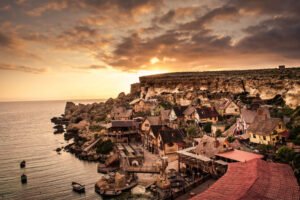
The presence of international film productions has contributed significantly to Malta’s economy and tourism industry. Visitors from around the world travel to Malta to see locations featured in famous films. For example, the set built for the film Popeye (1980) still exists today as “Popeye Village,” which has become a popular tourist attraction.
In recent years, Maltese cinema has also gained visibility in international film festivals and cultural events. Films such as “Luzzu” have been screened at prestigious festivals and have received critical acclaim for their storytelling and authenticity. Maltese filmmakers are increasingly collaborating with international producers and actors, helping bring Maltese stories to global audiences.
The future of Maltese cinema looks promising as the country continues to invest in film infrastructure, training, and international collaboration. Local filmmakers are exploring new genres and themes, while international productions continue to choose Malta as a filming location. With its unique landscapes, rich cultural heritage, and growing creative industry, Malta is increasingly recognized as a vibrant hub for filmmaking in the Mediterranean
There have also been cultural exchanges between Malta and India in the film sector. Maltese films and documentaries have occasionally been showcased in international film festivals that include screenings in India. These cultural exchanges allow audiences in India to experience Maltese storytelling while strengthening creative connections between filmmakers from both countries.
Through its combination of local storytelling and global productions, Maltese cinema has successfully carved out a distinctive place in the international film industry. The continued success of Maltese films and the country’s popularity as a filming destination ensure that Malta will remain an important part of the global cinematic landscape for years to come.